Bruce Springsteen & the E Street Band, Berkeley Community Theater, Berkeley, CA, July 1, 1978
“My mother and father, they’re here tonight."

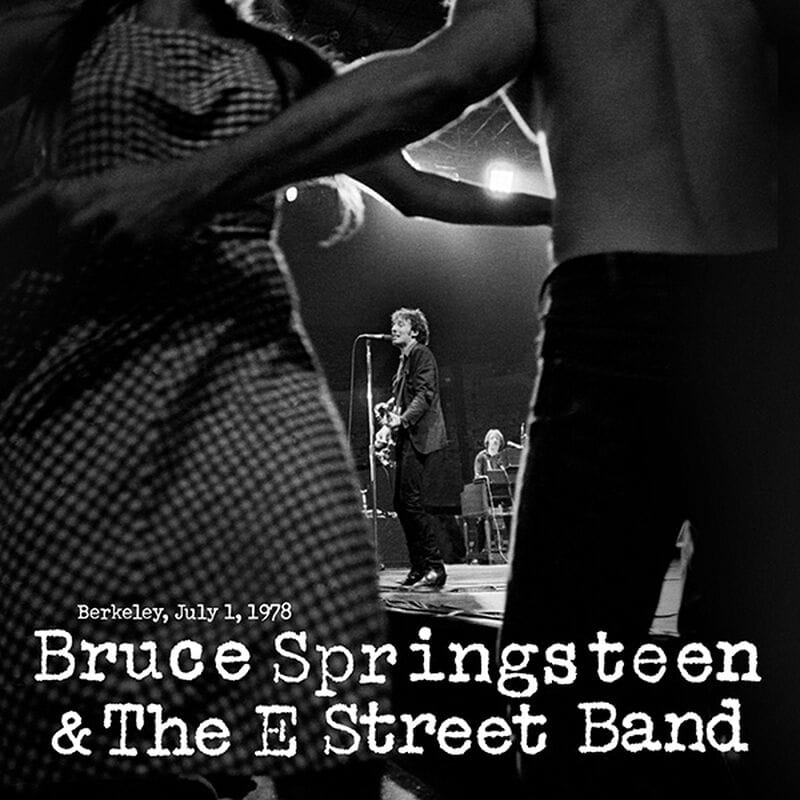
SETLIST: BADLANDS / NIGHT / SPIRIT IN THE NIGHT / DARKNESS ON THE EDGE OF TOWN / FOR YOU / THE PROMISED LAND / PROVE IT ALL NIGHT / RACING IN THE STREET / THUNDER ROAD / JUNGLELAND / PARADISE BY THE "C" / FIRE / ADAM RAISED A CAIN / MONA - SHE'S THE ONE / GROWIN' UP / BACKSTREETS / ROSALITA (COME OUT TONIGHT) / THE PROMISE / BORN TO RUN / BECAUSE THE NIGHT / QUARTER TO THREE
Capacity: 3,500
An official archive release
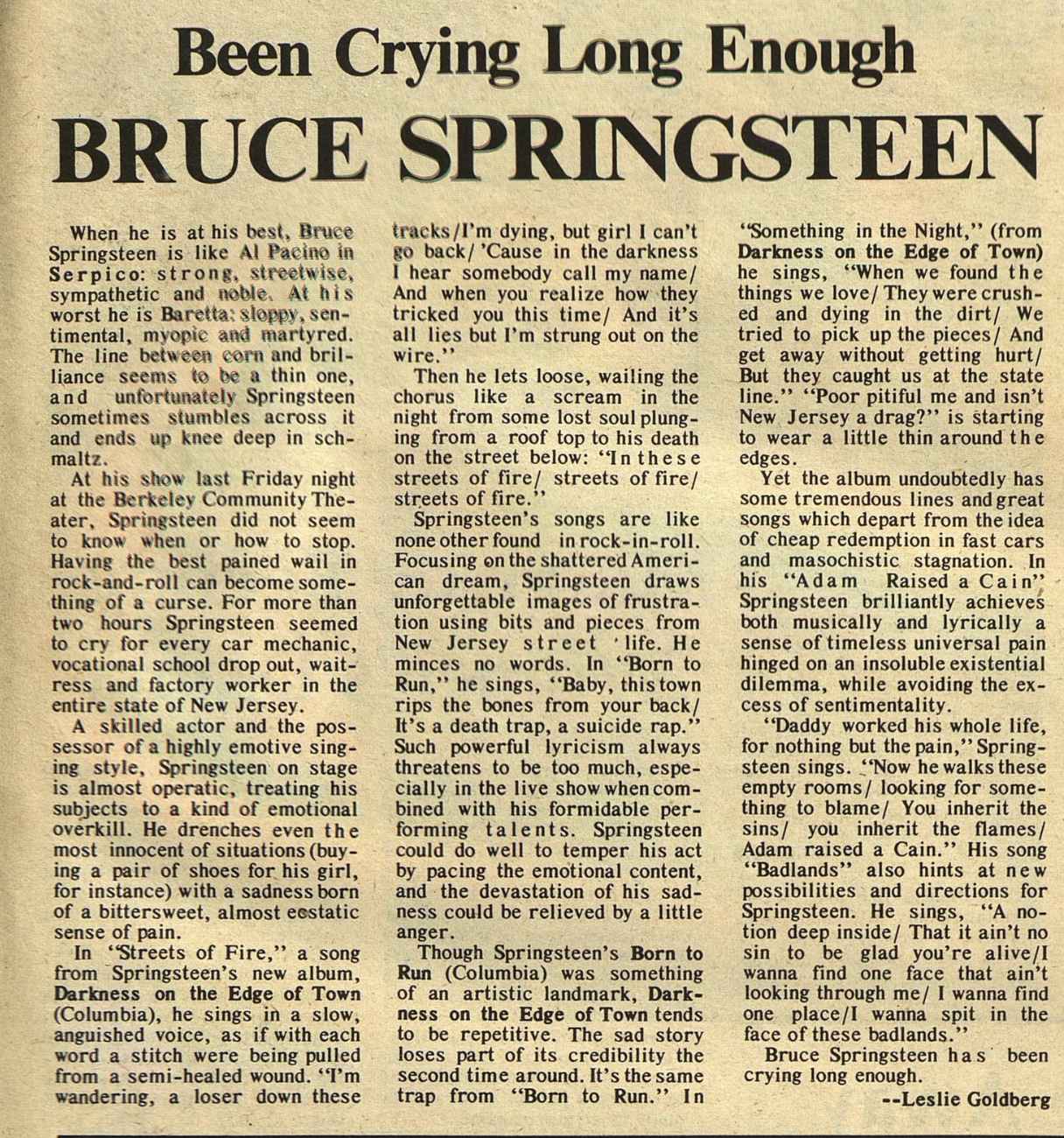
The E Street Band had been on the road on the tour to support Darkness on the Edge of Town for just a little over a month by the time they arrived in the Bay Area to play these shows at the BCT. This is the second of two nights, both sold out – everything was sold out. It had been a long time since Springsteen had been on the West Coast and the faithful were more than ready, they were rabid. Bruce and the band were too; while every 1978 show has its own particular mood and shading, there’s a sense of relief underpinning everything – the band didn’t break up or get jobs with other bands, the lawsuit between him and his first manager was resolved, there was a new record out, the fans were still there. But there’s still a sense that they’ve got something to prove: one, we’re as good as you remember (or heard), and two, we’re so good we can do that with ease.
That’s what you hear in “Night,” the second song in the set. They open with “Badlands” and it’s fine, it’s not rote, but it’s not special based on the standards of E Street. It’s well above average by any agreed-upon metric of rock and roll greatness, but compared to what would follow it was a starter. But “Night” is absolutely perfect, every second, every note, every flourish, emotionally attenuated so that the audience feels like they’re invited in. Bruce isn’t rushing, he’s taking his time – which, in a song with a deliberately frantic pace, takes skill – the harmonies with Steve Van Zandt are subtly shaded, Roy Bittan’s distinctive piano touches in the background create breathing room in a song that’s written to feel breathless, a song about finding solace in knowing that at the end of a workday is the space and time to breathe and escape.
There’s an absolutely exquisite vocal flourish halfway through the second to last verse, “you work nine to five” -- and then Springsteen pauses for a flash, it feels like down-shifting -- and then croons “till the night,” drawing the “i” in night out like a 50’s teenage heartthrob -- and he does it again at the end, slightly less pronounced, while Clarence Clemons’ sax solo glides through the drums and the bass and the keys, like he’s weaving his way through traffic on the Circuit.
“There’s a girl out there -- didn’t I meet you in the same place last night? I did! We gotta stop meetin’ like that, you guys are gonna start talking!” he jokes while tuning his guitar. “Darkness on the Edge of Town” gets introduced with a backhand nod to Berkeley denizen, rock and roll scribe Greil Marcus, with a comment about a book that meant a lot to him, called Mystery Train, which Marcus had published in ‘75. “Darkness” rumbles along with power and precision until the last chorus where Bruce modulates his vocals up, lending a whole new level of gravitas to the delivery of the song.
The core setlist of the ‘78 tour doesn’t differ drastically from show to show, which makes the fact that not one show feels identical to any other show that much more remarkable. Or maybe it's not remarkable because it’s just what normal was for Bruce Springsteen and the E Street Band. People knew, people had heard, people vowed to not miss him the next time. Next time was now.
“Prove It All Night” is introduced by a piano and guitar prelude that would later earn it the sobriquet “Prove It ‘78” to set it apart, to differentiate the standard take no prisoners, but get out alive energy you can feel from this one, which is the aural equivalent of lighting a long fuse and watching it burn. Bruce and Miami Steve harmonize with the lightest, deftest touch, he’s Bruce’s wingman, standing in the shadows but you can feel his presence. And then on the bridges, Springsteen punctuates the chord changes with this gutteral, primal “uh HUH” or just “HUHM,” a device unique to this particular tour. He’s not trying to be sexy, he just exudes at this moment a particular mix of musk and heat and desire, which later takes flight during the guitar solo.
This show in Berkeley wasn’t a radio broadcast, but it was (obviously) recorded, and this version of “Prove It” got broadcast to the greater Los Angeles area a couple of nights later when Bruce went on Los Angeles’ FM station KMET with DJ Mary Turner. The shows were all sold out, so he didn’t need to hype anything by broadcasting proof positive that the band was, you know, cooking with gas, but Los Angeles was still the epicenter of the music business, so if anything it was a simple... statement of intent.
“My mother and father, they’re here tonight,” Bruce tells us after the song finishes. He adds that his 16-year old sister is also in attendance, and that his mother had called him to bemoan that his sister is skipping school: “She don’t go to gym, she’s gonna fail gym!” and that she wanted him to call his sister and tell her she can’t do that. “I’m not gonna do that,” he says, “But I told her I’m gonna do something. So Pammy, there’s 3,000 people here tonight, and when the lights come up, they’re all gonna see you. So the next time you’re skipping school, chances are somebody’s gonna catch you.” The crowd cheers approvingly, and he dedicates “Racing In The Street” to her.
The transition straight out of the piano coda of “Racing” into “Thunder Road” is instantly epic, the kind of thing that confirms that Roy Bittan spent time playing in Broadway pit bands, that musical continuity isn’t part of the actual songs - two different worlds, two different lifetimes - but it’s a device that provides a reinforcement of the notion that Springsteen is writing about the same people as they move through their lives. So even if “Racing” came out after “Thunder Road,” it’s absolutely conceivable that that woman on the porch dancing to Roy Orbison would end up a few years later in the passenger seat of a ‘57 Chevy. Maybe he didn’t think of it like that at the time, maybe Roy just said, “Hey, I think this would be cool,” but he also didn’t not intend for you to make that connection.
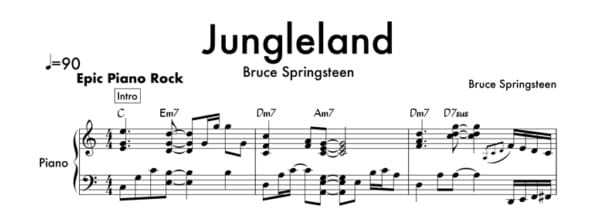
He sounds bemused by the depth of the applause that comes at the end of “Jungleland,” trying to tell the audience that they’re just gonna take a 15 minute break. They keep applauding anyway. On the other side of the break is “Paradise by the ‘C,’” an instrumental showcase that centered on Clarence Clemons, that fans know because of its inclusion on the unsatisfying Live 1975-1985 triple-album set released in 1986 that was meant to represent the live firepower of the E Street Band, but 100% did not.
“This is called ‘Adam Raised A Cain,’” Bruce announces before setting his guitar on fire and assuring that no one in the audience would ever, ever forget what the song was called. It’s hard to decide what the most incendiary element of this song is – the mid-verse licks Bruce peels off of the pickups, the HEY!sss from an E Street Band that all still had their vocal microphones, the emotional attenuation which Springsteen holds on the edge of a switchblade. It’s not feral, but it is quietly furious, which gets louder at the bridge where the band vocalizes that wordless formless whoaaaaaaaa - the wolves are circled and poised to attack - and the leader of the pack yelps to bring everyone to attention before sliding into the last verse. The war cry comes back through at the end as Max starts the Bo Diddley beat and the wolf pack keeps yelping straight into “Mona” and then the keyboardists take the lead and Bruce maneuvers into “She’s The One,” which is definitely, decidedly feral. Clarence shakes the maracas, and Steve’s rhythm guitar grounds them in place. It is breathtaking.
When the song finishes and the crowd is done applauding, there’s about a minute where Bruce is tuning the guitar, and the audience doesn’t yelp, doesn’t scream, they just sit there quietly, in what sounds like a daze. But they spring back to life as soon as Roy Bittan starts the piano introduction to “Growin’ Up,” a quick burst of excitement as they all quiet back down because this crowd in Berkeley knows that it’s storytime.
“I went to this Catholic school…”
wild applause
Bruce, confused: “You couldn’tve went there!” It always bemused him, when mentions of New Jersey would garner vocal reactions from audiences thousands of miles away. It took him a while to figure out that they weren’t trying to say they were from New Jersey, they were applauding the stories, or the idea that now they were going to get to listen to Bruce Springsteen tell stories. Also, New Jersey was usually only ever mentioned in popular culture as some kind of punch line. Nothing great came from New Jersey, usually.
After the first verse, Roy plays the repetitive piano motif he used as the background to Bruce’s storytelling in this particular song.
“I remember when my father -- this is where I get to stick it to ‘im, because he’s here tonight -- I remember when I was first playing, he couldn’t figure out what kind of make guitar i was playing. He didn’t know if it was a Fender guitar, or Gibson guitar - all I remember is him sticking his head in the door and saying, ‘Turn down that goddamn guitar!’ He always used to refer to it as ‘a goddamned guitar.’” So I was thinking - he must’ve thought that all the stuff in my room was the same make because it used to be, ‘Turn down that goddamn radio!’ ‘Get that goddamn record off that goddamn stereo!’ he giggles, the crowd applauds. This is one of the earliest instances of this particular story, of Doug Springsteen and the goddamned guitar. He’ll pare the story down but keep the riff about the goddamned guitar, and tell it at the Roxy the following week where it would be broadcast on FM radio and be recorded on hundreds of cassette decks. In turn, that version of “Growin’ Up” from the Roxy would later show up on the Live 1975-1985 compilation. This is how the stories became canon.
“He used to give me a hard time all the time, he never used to let it up. He was always, ‘Turn it down! Turn it down! Turn it down!” you know? I’m gonna invent a line of goddamned products, the only thing that they got special is, they’re louder.” Bruce clearly thinks this is hilarious. “So tonight, I got three million watts, I'm playing 100 times louder than my stereo ever was, and he comes to see me! He wanted me to be a lawyer, and my mom, she wanted me to be an author. But tonight, they both gotta settle for rock and roll.”
And BOOM. The entire band hits their marks and takes us back into the song. It’s cute, but it always felt a little self-conscious. Bruce’s parents left New Jersey for California in 1969, so there hadn’t been a whole lot of opportunities for them to see their son performing live. Now he was doing pretty well for himself; Bruce had told stories about his dad and about growing up, but he wasn’t usually doing it with the subject of these tall tales (at least we hoped some of it was fictionalized) sitting in the room.
But if you wondered how he actually felt, you’d figure it out during the next song. “Backstreets” has always been a vehicle for exasperation and frustration and it is always intense, but tonight it is close to atomic. He neatly disguises it here in the middle interlude, an improv that the fans called “Sad Eyes” because of the lyrics, but that has a tie to what’ll become The River’s “Drive All Night.”
To be fair, “Backstreets” carries a lot on its shoulders; on earlier tours, Bruce would tell stories about running on the beach and sometimes there’d be a guy named Billy with a shotgun, just shooting into the darkness. Tonight it’s just all just a volcano of emotions that are probably a mix of heartbreak, unresolved parental frustrations, leftover lawsuit anxiety, and anything else currently rattling around Bruce Springsteen’s head. It is colossal; it is seismic.
“The Promise,” the song that is not about his lawsuit with his manager, but absolutely is about the now-settled lawsuit with his now-former manager, features Bruce on piano all by himself. He dedicates it to his father, which is a fairly loaded gesture even if you don’t start trying to unpack what he means. “My dad he taught me how to walk quiet / and to make my peace with the past” is all well and good, but this song is absolutely about deep betrayal and it is sad and heart wrenching. There’s no band to hide behind, there’s no one to cover for him, it is him and the absolutely silent audience.
Their reward for their attention is the rapturous three-song conclusion of the encore, the party of “Born to Run,” “Because the Night” – Patti Smith’s version had just peaked at #13 on the Billboard Hot 100 the previous week – and the ecstatic, always over-the-top “Quarter to Three.”