Bruce Springsteen & the E Street Band, Hill Auditorium, Ann Arbor, MI, September 23, 1975
“We’ll do this for Bob Seger.”

SETLIST: THUNDER ROAD / TENTH AVENUE FREEZE-OUT / SPIRIT IN THE NIGHT / PRETTY FLAMINGO / GROWIN' UP / IT'S HARD TO BE A SAINT IN THE CITY / THE E STREET SHUFFLE / SHA-LA-LA / SHE'S THE ONE / BORN TO RUN / BACKSTREETS / KITTY'S BACK / JUNGLELAND / ROSALITA (COME OUT TONIGHT) / DETROIT MEDLEY / 4TH OF JULY, ASBURY PARK (SANDY) / QUARTER TO THREE / CAROL / TWIST AND SHOUT
Capacity: 3,500
The recording opens with an initial wave of applause for the opening lines of “Thunder Road.” It’s less than a month out since the album’s release; the single was the title track, it’s a stunning solo-piano TR (the Professor on the ivories) and the audience is stunningly silent, listening; they applaud warmly and with enthusiasm. They weren’t quiet because they didn’t know the song, they were quiet because the performance demanded it.
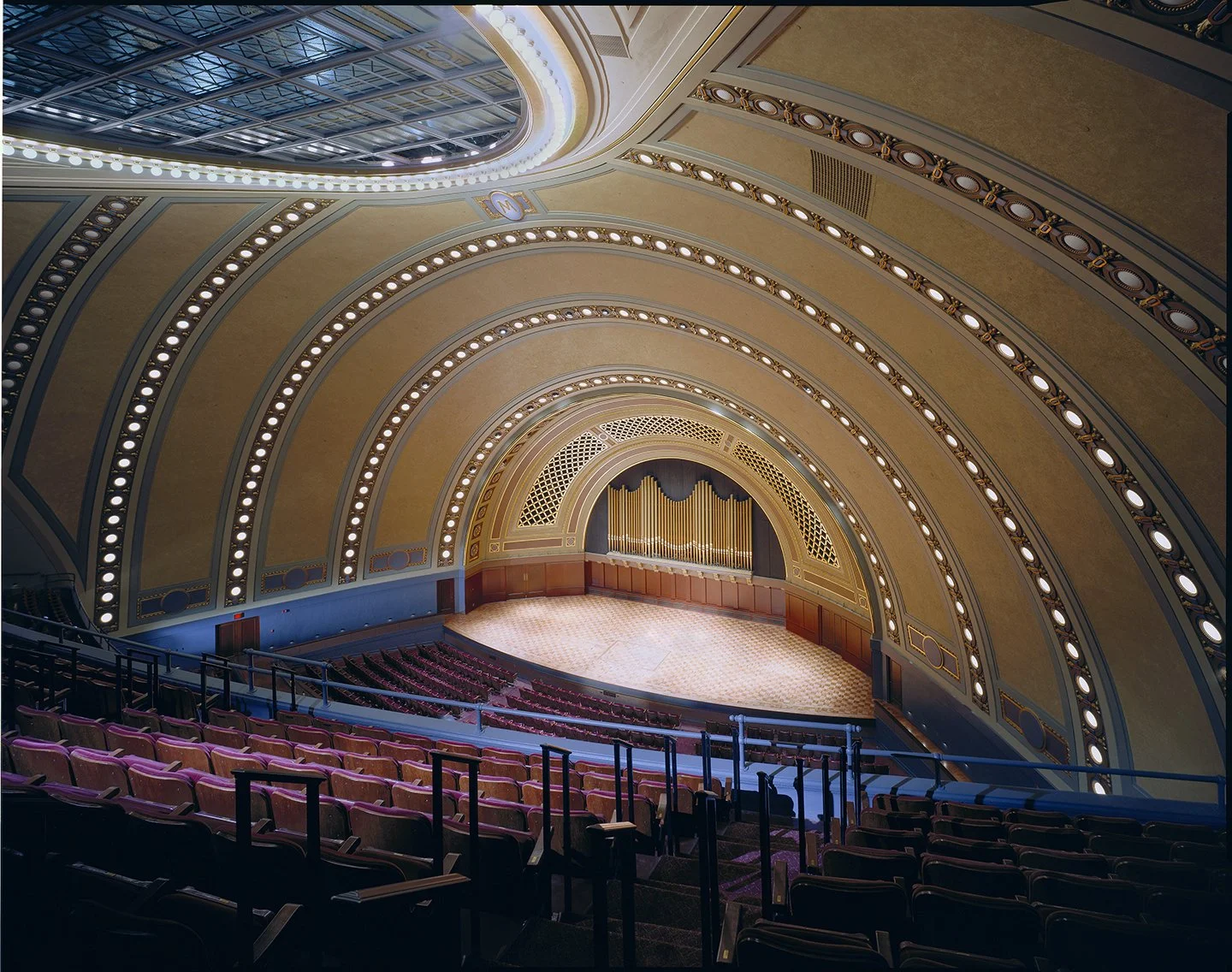
Hill Auditorium in Ann Arbor is a deceptively named venue. I bought tickets to see Dylan there not long after moving to Detroit in 2019 and thought it was going to be some gymnasium-shaped, boxy and unremarkable venue. It is the complete opposite of that; it was built in 1913, designed by Albert Kahn, it’s a gorgeous 3,500 seat theatre, ancient wood and beautiful resonance -- the acoustics are stunning, even all the way up in the upper reaches of the balcony.
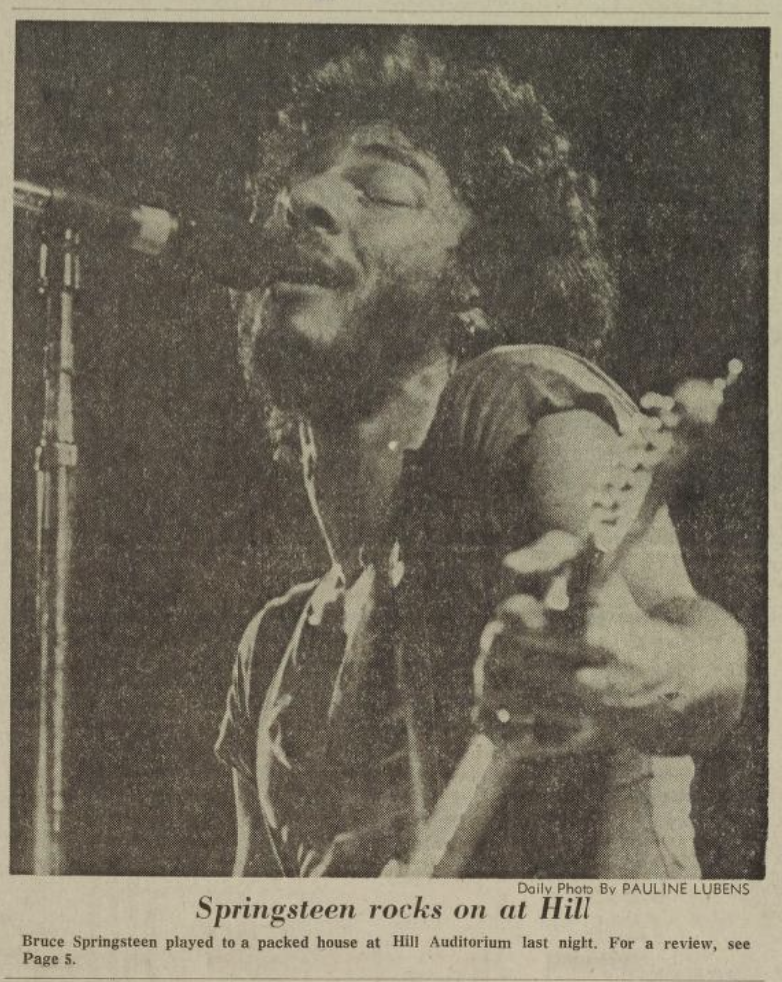
The tape tonight, as you can hear in “Tenth Avenue,” is a little echoey, which makes me think it wasn’t a sold-out show, even though this show got moved from a smaller venue to Hill Auditorium in anticipation of demand and as you can see from the caption on the photo that was on the front page of the Michigan Daily, it was a "packed house." It’s unfortunate we don't have a recording of greater fidelity because this is a birthday show on the actual date of birth and a clearly exemplary performance, which you might have suspected with that version of “Thunder Road” but is confirmed with the vocal performance on “Spirit in the Night.”
“The night was clear and the moon was yellow, and the leaves came tumbling down,” Bruce quotes from “Stagger Lee” in the intro, spoken-word style. Some day I really need to dig into the places he kept trying to use this song as some kind of replacement for the longer-form aural world-building the band used to do at the start of “Spirit” (or that might just be the extent of it). He’s clearly crawling around on the floor or out in the audience based on the applause and laughter right around the Crazy Janey line; our friends at JEMS explain in the readme that it seems that Bob Seger himself was in the front row and Bruce ended up in his lap during that sortie out into the crowd.
Listen to him move from conversational to whispers at the end of the final verse and how the audience quiets right down before E Street moves right in like a SWAT team to finish the number. It’s as good a version of “Spirit” as you’ll ever get in this era.
“Pretty Flamingo” got introduced to the set as a full number about two weeks earlier in Houston. He tells the story about living on South Street: “Steve, my guitar player, used to come by” – for some reason he feels the need to be specific as to which Steve he’s referencing; Mad Dog also gets name-checked. The echo is not our friend for the story initially, but we’ve all heard it so you can keep going until the fidelity improves. The punchline is, of course, that they never had the courage to approach her and eventually Bruce left town.
It’s about four minutes of story and four minutes of song, which is a reasonable ratio for this moment on this tour in these increasingly larger venues, playing in front of people who – like our friend, the late Jared Houser, for whom this was his first Springsteen show (not his first recording – he explains his eight-track got confiscated on the way in) – had never seen him before and don’t know what the show is like. The combination of impassioned vocal delivery and tasteful guitar licks makes this an especially outstanding version of “Flamingo,” especially towards the end when Bruce seems to have figured out the hall’s acoustics and how to use them to his advantage.
People in the audience recognize the initial piano motif for “Growin’ Up” and respond with enthusiasm; this is a fairly nitro-charged version, just the song, no deviation off into storytime. And that energy slides right into “It’s Hard to be a Saint in the City.” It’s about here you’ll be wishing there was a soundboard of this show. Danny Federici in particular is having a great night and that level of color and vibe only enhances this particular song. Clarence is holding the band down to the ground and Bruce is in full command of all of his powers, which will be of particular interest when they get to the bridge and it’s time for the guitars.
But when they do, he deviates from the usual protocol, and gets the band and the audience to sing a background riff for them to decorate, but then he holds back, maybe he changes his mind. Roy contributes a little here too, gets off a couple of sparkling riffs and it’s him and Max that then lay down the bottom and that’s when we finally get the face off between Bruce and Steve, less a duel than an exhortation. The band builds behind them, louder, more insistent, and it all turns into one enormous and joyful noise before Bruce cues the band to shut it down, flawlessly. They stop on a dime.
You hear Max’s drumstick on the snare rim and the audience decides they want to clap along. Roy comes in with an expanded, almost harmonic take on the intro to “E Street Shuffle” before Danny slides in alongside him and turns it into something you could recognize if you’d ever heard it before. Most of this audience has not and they thankfully abandon any attempt at keeping time. If you thought that maybe Bruce was ready to abandon some of the epics, the 22 minutes and change of “Shuffle” will reassure you.
“BAND!” he invokes twice in the intro, probably just because he could, because he knew the power of the six men behind him. He’s telling the story we all already know, of how he used to have this band, “Mad Dog and Garry and Davey” -- Sancious gets his own applause! -- and how they were looking for work, but they couldn’t find any, “this big influx of bands, like, from Long Island, you see” (uttered with the specific kind of disdain only someone from New Jersey could offer when talking about that part of New York), how if you didn’t have some kind of “big Vanilla Fudge type-influence…if you didn’t have that type of stuff happening, you wasn’t happening!” They had everything, Bruce insists, even a bass player with long hair (laughter and applause). “We were missin’ X, like algebra” – gets big applause from the room full of University of Michigan students. They’re walking home, down the boardwalk, and Steve has his guitar, he practiced in the shower, “he practiced when he was kissin’ his girl…”
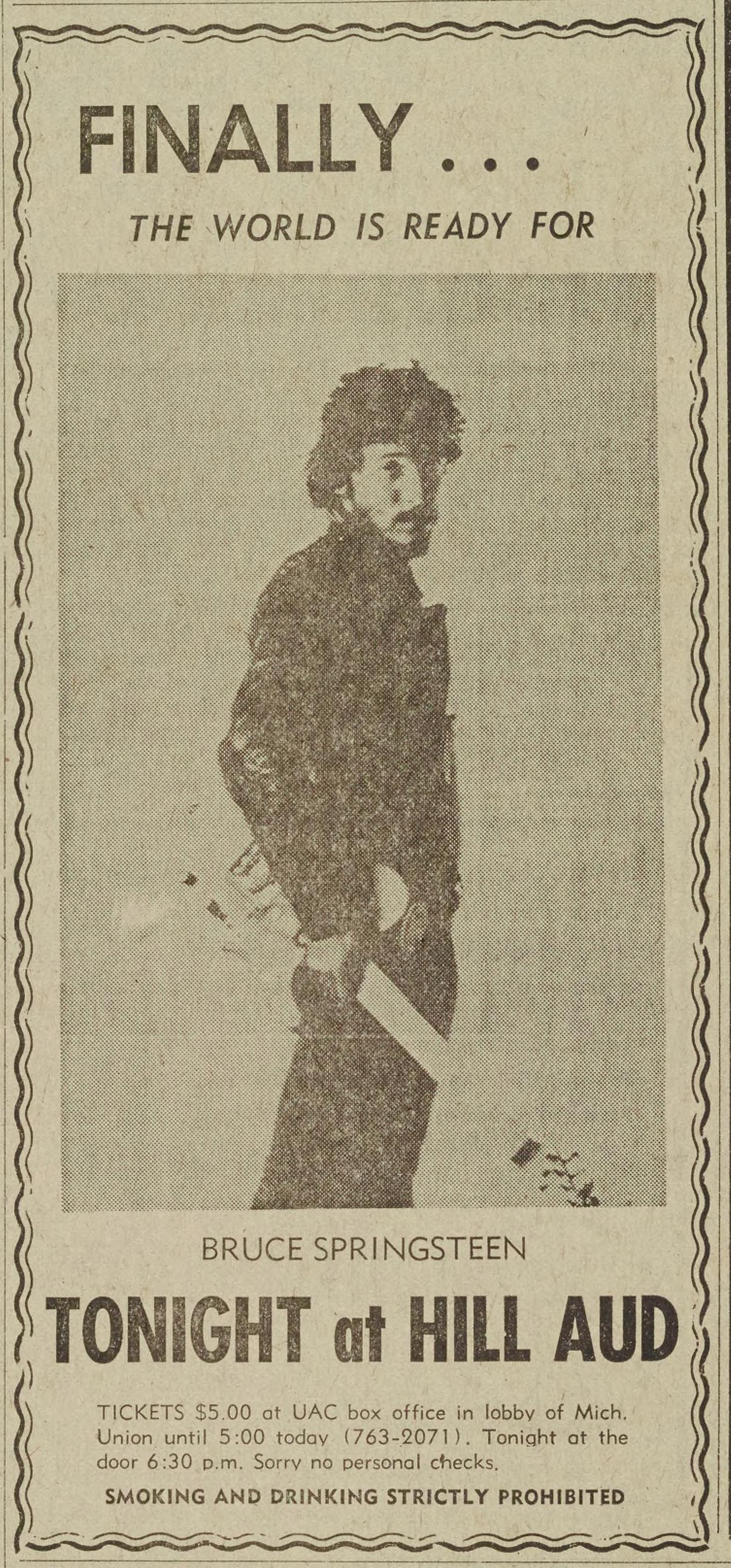
Tonight, Clarence appears down the boardwalk as “a big cloud of mist, dressed all in white,” and we know from the pictures in the Michigan Daily, the student newspaper (that link is very much worth the click) and from previous outings in this era that the Big Man was wearing a white suit, “and carrying a saxophone.” He lets off a very heartfelt refrain on his horn, in the middle of the story, halfway through, at about the 11 minute mark. Like the story Bruce told at the Bottom Line about going to see Madam Marie and having to show leadership, here the leadership manifests as the standard move of throwing everything of any value down on the ground, before that rimshot and the song finally begins.
Clearly, no one told the band how close they actually were to Detroit because Clarence tells us about “East Coast muscle.” COME ON NOW
But C.’s sax work at the end is delicious, once again “having a party all by yourself…with the saxophone,” but it’s interplay between Clarence, Bruce in a whisper, Roy dancing around the edges. There’s solid, enthusiastic applause at its conclusion. It’s followed by a high-speed gallop through an absolutely frenetic “Sha-la-la,” which E Street have made their own at this point. It’s so airtight that it doesn’t give Bruce as much room to play with the vocals, but it is a triumph for the band.
“We’ll do this for Bob Seger,” Bruce says, with barely a breath before the band commences to conjure up “She’s the One.” It’s the same aural world-building that they used to do for “Spirit in the Night” except that they’re better at it now, they know how to set the tone in seconds instead of needing a minute or two. The Seger introduction might hint a little at the reason the band is so fucking good here, that kind of respectful one-upmanship directed from one hometown hero to another one. We see you, we know you, we even like you…but we’re also the E Street Band.
If you love a STO with the band on full-throated backing vox, this is definitely for you. But mostly, they are just cooking with gas on that stage. It’s a very muscular rendition, more direct, shall we say. This rolls into a more robust “Born to Run” which is finally feeling more like a triumph as opposed to a chore that has to be rushed through. It’s still entirely too fast.
But all is forgiven as Roy plays in the intro to “Backstreets,” and you have to think about the 3500 people in that room who are about to have their minds completely blown. The emotional intensity is perfect, it’s not overblown, it’s not rushed through, Bruce is present and centered and his vocal delivery is magnificent, while the band delivers a flawless performance behind him. If you don’t listen to anything else, listen to this.
Backstreets - live in Ann Arbor 9-23-75
But this was all just a runway into the stunning ensemble work that is this particular version of “Kitty’s Back.” Whatever echo was torturous earlier seems to support every instrument, every performance, every solo. The audience isn’t hooting or talking or doing anything except paying attention because it is quite simply breathtaking. There’s a moment towards the end of the song, as the bridge is winding down, where they’re riffing, but they’re riffing with such precision, they’re locked in, following each other and their memories and also obviously keeping their eyes on Bruce – of course we can’t see this but we’ve seen them do it enough to know that is exactly what is happening right now because otherwise this entire thing collapses – who’s off singing a couple of lines of “Nothing’s Too Good For My Baby” before switching into sentinel mode: “Here she comes.” The band narrow their focus, jump in on the backing vocals, and with about three minutes left, Bruce lets out a high-pitched squeal and E Street instantaneously swing into the final chorus. It is breathtaking.
To quote our friends at JEMS, “This is a perfect example of a show that probably has not gotten its due because it wasn't a radio broadcast or a famously high-quality audience tape.” Because this rendition of “Kitty’s Back” is the stuff of legends.
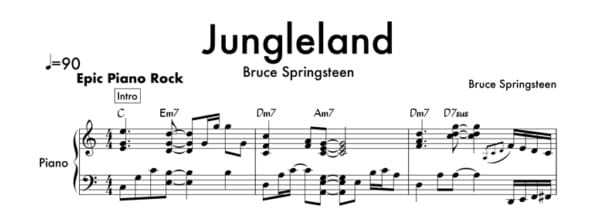
I would have had to sit down, but would have then sprung right back up as soon as I heard Roy usher in “Jungleland.” There’s a pregnant silence, the audience is still energetically engaged; there’s a brief smattering of respectful applause from people who clearly recognize what song it is. And it’s coming in at the same level of focus and intensity the E Street Band has been delivering all night. Listen especially how Max hits that drum roll at “the hungry and the hunted,” and the precision with which the band attack this particular number. There’s a relaxation behind Bruce’s voice, the vocalization of someone who feels completely centered and present in what they are singing. I mean, that’s something you can almost always say about him, but in this particular era there’s a different tone to the confidence being projected. Go back and listen to Providence, then Akron, then the Bottom Line, and compare them. The evolution is remarkable. The applause at the song’s conclusion is an appropriate acknowledgement towards what's just been presented.
Then, there’s some Spanish tinged guitar riffing, “Some folks said, it happened in Minneapolis, that’s what she said, other folks said it happened in Paris, but actually, it was a little cafe….”
~ castanets ~
“On the other side of the border…”
~ maracas ~
A little bit of "Come A Little Bit Closer," as per usual, brings us down San Diego way. There’s hooting and hollering in recognition, and then that moment when the cork comes out of the bottle and it’s PARTY TIME. Earlier in the evening, there were people yelling for “Rosalita,” and even though this is the band’s first Michigan appearance I’m going to guess (especially based on one of the reviews in the Michigan Daily) that we are dealing with a dozen or so East Coast expats attending the University of Michigan who clearly have seen this show before. There could also have been a contingent of folks from Ohio, who had been seeing Bruce since 1974 – it’s really not that far.
“This is for Mitch Ryder,” Bruce says, and the crowd reacts appropriately for a Michigan audience -- no one is prouder of a local artist than people from Michigan, and I say that with great respect and enthusiasm -- but no one, absolutely no one, knew what was coming, and what it would become later, how it would turn into one of the E Street Band’s calling cards, their guns drawn challenge. The first “Detroit Medley” ever! It launches and E Street are on point: it is crisp, organ-heavy, drums on point, executed with precision and 100% faithful to the original.
His voice has warmed up now and while Bruce Springsteen can’t sing blue-eyed soul he can sing soul and he had no doubt he and E Street could land this particular cover, performed for the first time in its homeland. “Devil With the Blue Dress,” “Good Golly, Miss Molly,” “CC Rider,” and then “Jenny Jenny” -- listen to Roy hitting the chords with verve and precision, listen to SVZ’s sharp harmonies, listen to Danny adorning the verses -- and then: “Bring it down now…hold that thing there,” Bruce commands, firing off some guitar licks while the band vamps and then they segue into “Back in the USA.” Which is an abundance of motherfucking riches.
“I wanna thank everybody for coming down tonight and let you know we really appreciate it. We ain’t ever been up this way before and I wanna thank you all for giving us such a fine hello. Here’s something for you all, from Asbury Park, with love,” and it’s “Sandy.” Take a breath. Drink some water. Admire the accordion work. Maybe sit down, because the next three songs will send you out into the aisles.
“In the immortal words that echo through the annals of rock and roll history, I would like to say: 1, 2, 1234!” “Quarter to Three” is turbocharged, spotlight on the Big Man. There’s a cut at the start of “Carol,” which is sad because it’s a steamroller just like the previous 10 or so songs, but there’s still enough to appreciate what's happening.
“Clarence, play me that riff that you play…” and Bruce lets him riff for a bit, talks about the Funky Chicken, so there’s definitely some dance moves being executed on the Hill Auditorium stage. And no disrespect to the Big Man, but the person you need to listen to here is -- unsurprisingly on a Chuck Berry song -- Roy effing Bittan. So much precision and verve.
After a lengthy, loud and enthusiastic applause interval, Bruce returns (or at least approaches the microphone, we don’t know if they were offstage for the encore break) and explains that this was the first song he ever sang with a band. In 1975, “Twist and Shout” is still magical, we’re only 11 years out from Beatlemania invading our shores, it isn’t a gimme, it isn’t old, it isn’t tired, it doesn’t go on too long.
“This is the part where the band sneaks out,” he says towards the end. The crowd expresses their disappointment at this statement. But they’ll be back in a few weeks at the Michigan Palace. And Ann Arbor is only 45 minutes from Detroit. It was the beginning of a beautiful friendship.
Listen or download - Hill Auditorium, Ann Arbor, MI, 9-23-75