GUEST POST: "Death to my Hometown," by Marc Dolan
"The E Street Band feels more like a blunt instrument than it has in ages."

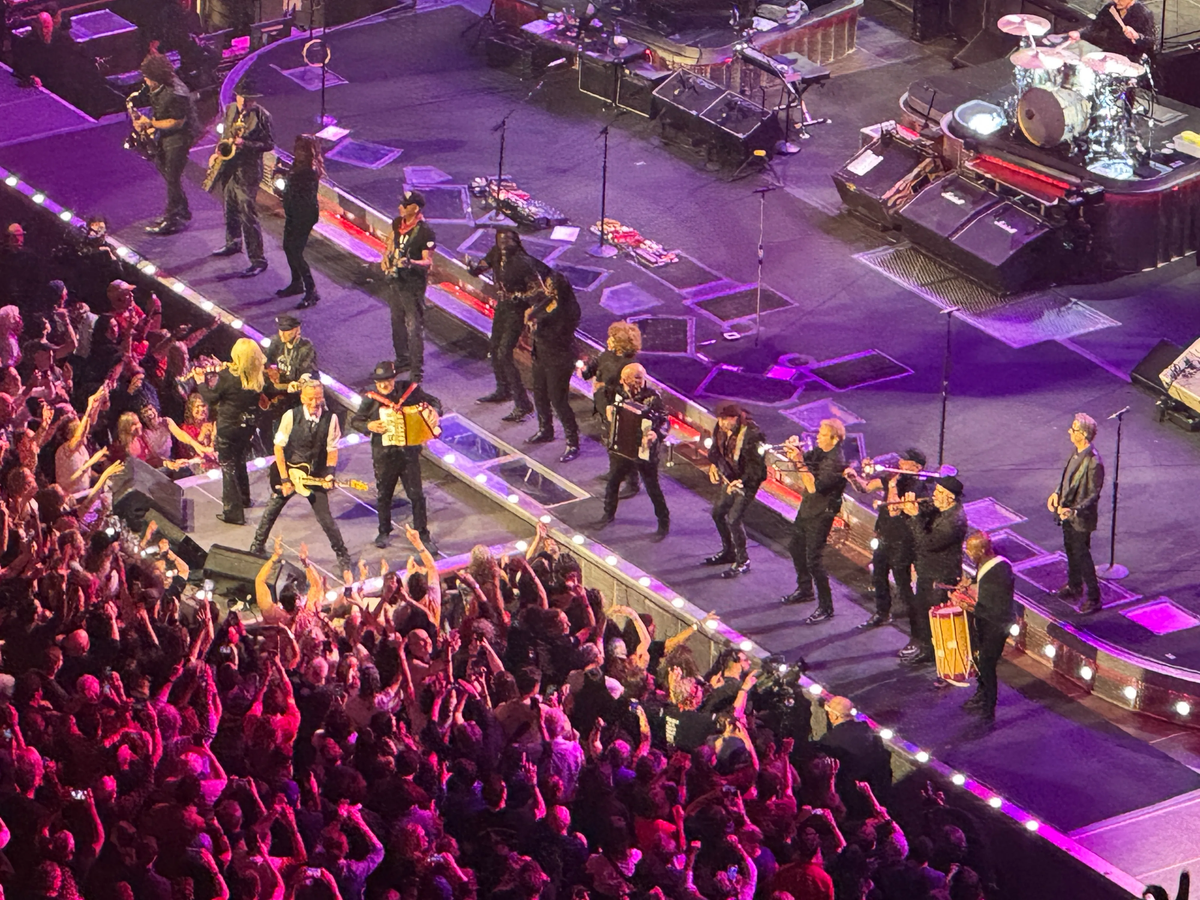
I had the privilege of meeting Marc Dolan when his fantastic book Bruce Springsteen and the Promise of Rock 'n' Roll was published in 2013. We did a couple of book events together and have been pen pals ever since. His book is always close at hand when I am working on something Springsteen-related. After he saw the show at Barclays on May 14, I woke up to a text where he lamented that he didn't have an outlet to publish his thoughts on the show, so I promptly offered him space here. Next report from me will be tomorrow in Pittsburgh.
As brilliant a writer and musician as Springsteen is, for the first decade or so of his career he thought about politics the way most Americans think about politics—anecdotally, not systematically. From the late 1960s through the early 1980s, only one political cause seemed to occupy Springsteen’s mind: the Vietnam War. He namechecked Vietnam vet Ron Kovic from the stage during one of the Winterland concerts in 1978, brought the E Street Band to play a benefit concert for the Vietnam Veterans of America in 1981, and wrote “Born in the USA” shortly after performing at that concert. At that point in his life,, though, Springsteen’s politics didn’t go all that far beyond that single issue. We needed to avoid another Vietnam War, and especially the induction of thousands of young American men as potential rocket fodder. Throughout the 1960s, 1970s, and early 1980s, that seemed to constitute the length and breadth of Bruce Springsteen’s political agenda (if you could call it that).
His political alarm clock went off on the fateful day in September 1984 when Ronald Reagan namechecked him approvingly in a stump speech in Hammontown, New Jersey. True, Springsteen had spoken from the stage on the night after Reagan’s original election to the Presidency about being scared for the country, but he was very vague about what he was scared about. I myself have long suspected that he was mostly thinking that night in 1980 that a Reagan presidency would get his country into “another Vietnam.” That’s certainly the sentiment that led to one of his most famous covers, the E Street Band version of Edwin Starr’s “War,” which they premiered at the LA Coliseum in September 1985 during the last four dates of the Born in the USA tour.
I don’t think anybody has ever commented on it, but even for a newly awakened liberal like Springsteen a sudden renewal of the United States draft shouldn’t have been an overpowering fear in September 1985. Many rockstars of Springsteen’s generation voiced similar fears (most notably his friend Jackson Browne in the title track for his album Lives in the Balance, which Browne had recorded in LA during the months just before Springsteen’s Coliseum dates). As the gradual unraveling of the Iran-Contra scandal would play out in the press and in Congress over the next several years, it became abundantly clear that the kinds of wars that the Reagan administration wanted to wage were covert, limited ones. At no point during his eight years in office did Ronald Reagan seriously consider reactivating the military draft that President Gerald R Ford had deactivated ten years before. In other words, when Edwin Starr had originally sung “War” in 1970 it had addressed in full force one of the most pressing public issues of its time. When Bruce Springsteen and the E Street Band performed the song fifteen years later, even its politics were mostly nostalgia.
I thought about all this last week as I watched Springsteen open the Brooklyn date of the US Land of Hope and Dreams tour with that very same cover. Now, over half a century after Ford deactivated the draft, we have a Secretary of Defense—excuse me, Secretary of War—who wants to make the Selective Service System much easier for the executive branch to employ. We also have a President who . . . well, more about that later.
By opening all the dates of his 2026 US tour with “War” swiftly followed by “Born in the USA,” Springsteen is throwing his audience right back into 1985. But in this year’s specific concerts these songs do not feel like nostalgia. They feel contemporary, even urgent.
One of the most striking things about this tour and its unvarying speeches and setlist is its lighting design. Rather than the usual play of warm and cool wash, the lights during the show come in four bold colors: red, blue, green, and white. At the beginning of the concert, Springsteen addresses the crowd in near-darkness, laying out his explicit mission statement for this stateside tour.
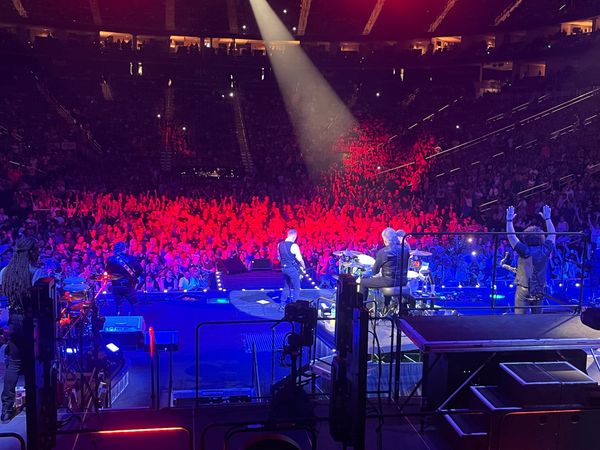
"The mighty E Street Band is here tonight to call upon the righteous power of art, of music, of rock ‘n’ roll in dangerous times," unfolding a list of deliberate, positive choices that he wants the audience to make. The list ends abruptly when, after relative darkness, the white lights explode—there is no other word for the sudden shift— many of them shining directly into the audience’s unaccustomed eyes. Simultaneously, the band turns on a dime to begin “War,” and just as suddenly the lights shift from that blinding white into a bath of bright red, all over the stage, as well as on most of the floor seats and General Admission. Under these symbolically hellish conditions, the E Street Band feels more like a blunt instrument than it has in ages. Even its older, most venerable members seem fiercer on this tour, with “Born in the USA” directly following “War” in one of the most assertive versions of that song that I’ve ever heard in concert (so much so that I was already hoping, two songs in, that Max Weinberg would get a chance to properly ice his wrists three hours later after the concert concluded). As I said, performed in this way, that opening two-shot from 1985 does not feel nostalgic. It feels contemporary.
And the next two songs—2012’s “Death to My Hometown” and a cover of The Clash’s 1979 “Clampdown”—continue to make past songs feel contemporary, as well as part of one long ferocious howl, much like the nonverbal one that has closed out “Born in the USA” since its first band recording. Both “Death to My Hometown” and “Clampdown” are about resistance, even armed resistance, against overpowerful “robber barons.” In this mood of urgency, the band is mightily aided by the highlighted inclusion of activist-guitarist Tom Morello, formerly of Rage against the Machine, the strings of whose guitar spill flagrantly out of its headstock and the body of whose guitar is decorated with the duct-taped slogan ARM THE HOMELESS.
 Caryn Rose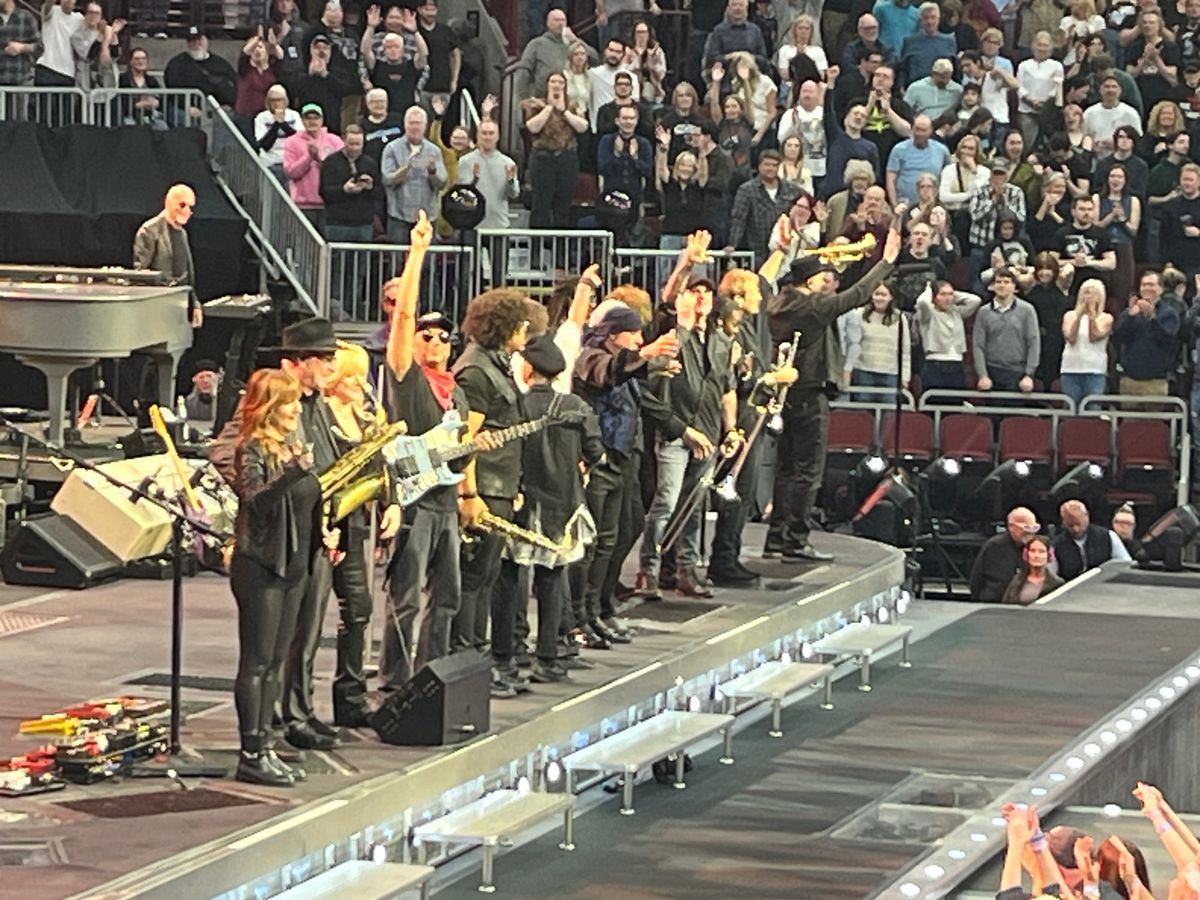
Thematically, those opening four songs present a unified howl of rage against those in unearned power, but musically they are a striking mélange, which signals the implicit part of Springsteen’s mission statement. A soul cover and a punk cover bracket a clear classic rock song and a faux Irish revolutionary broadside—and all these songs belong together in Springsteen’s America. Each style is distinct and respected in its own right and yet each song flows unquestioningly into the next. From the start of this concert, there are nineteen performers onstage, even larger than the first hippyish bands with which Springsteen played back in the early 1970s. The musicians and vocalists display a range of ages and racial and ethnic attributes, and nearly everyone onstage plays multiple instruments, even within that opening quartet of rageful songs. In this carefully constructed concert, that mix isn’t chaos. It doesn’t court division. The mix is where the magic lies. It’s as perfect a musicological representation of E PLURIBUS UNUM as live pop has ever presented. Springsteen has played with this sort of mixing of styles and personnel almost by instinct since his earliest days as a performer but a half-century in it now seems even more intentional. This bricolage is not just aesthetic. It’s ideological.
I always find it striking how contemporary Springsteen’s audience allows his work to be. Is there any other popular musician who started recording over fifty years ago whose fans let him get away with singing this many relatively recent songs? Of the twenty-seven songs in this tour’s standardized setlist, well over a third of them were written in the twenty-first century. When you consider that another four songs date from the 1990s, over half the songs Springsteen performs on this tour date from after the peak of his popularity in the mid-1980s. This may be a legacy act, but it’s not an act that’s stuck in the past.
Then again, even back in the 1970s, Springsteen was very clever about the way in which he would juxtapose older songs with newer ones. At their best, these juxtapositions highlighted missed features of the old material when he sang it before or after the new. Much of the time the juxtapositions were mostly stylistic or rhythmic, but on some tours (most notably 1988’s Tunnel of Love Express tour), Springsteen has been careful to curate a selection of songs that link up with each other thematically. That is what he has done here, but this tour isn’t about Love. It’s about Politics. More important, it’s about Ideology. By the end of the concert Springsteen presents his most deeply felt ideology in a more explicit and articulated form than he has ever done before.
For within Springsteen’s career the US Land of Hope and Dreams tour is relatively unique. It wasn’t designed to promote a new album, not even a new compilation of previously unreleased tracks. If Springsteen and company are to be believed, this tour wasn’t even originally planned. It came about specifically as a response to current political conditions and was jump started by the composition of a single song. That in itself is a signal occurrence at this point in Springsteen’s career. It’s not often observed, in part because Springsteen regularly releases new albums, but over the last sixteen years he appears to have written only about a half-dozen wholly new songs.
Beyond that, I can’t think of another of the hundreds of songs that Springsteen has written over the last six decades that he wrote, recorded, and released in well under a week. (That kind of compositional speed was much more a trait of the late Joe Strummer.) An inveterate tinkerer, Springsteen has sat on tracks for literally decades, noodling for ages over how he might perfect them. Nevertheless, following the protests against ICE overreach in Minneapolis in early January of 2026, Springsteen wrote “Streets of Minneapolis” on 24 January, recorded it on 27 January and released it digitally on 28 January.
Watching Springsteen sing this song in concert--first verse solo, then with the band—strikes me as the most explicitly political that I have ever seen him onstage. In the past, when he has led an audience’s responses to one of his songs, it was usually to add some handclaps or “li-li-li”’s to a chorus, but with this song he leads the audience in a triple chant of “ICE OUT NOW!” Previously, such specifically political in-concert rabblerousing was much more the province of post-punks like Morello and Springsteen’s acolytes in U2.
I don’t know how such clear rabblerousing played in earlier concerts on this tour in Sunrise, Florida, or Atlanta, Georgia, but in Brooklyn last week the audience was solidly with him. Truth be told, I saw more political discomfort in a Springsteen crowd on the Magic tour back in 2008, with its tentpoled critiques of George W Bush and his administration. At this concert, there was less milling about and heading to the concession stands when Springsteen launched into yet another “political” song.
 Till Victory Press
Maybe that’s because, over the last two decades, Springsteen has definitively burned off many of the sleepy fans who reflexively thought that “Born in the USA” was a song about blind patriotism. However, it may also be because on previous tours the political songs felt like interludes, while on this tour nearly all the songs feel like political songs. When Springsteen started a tour in 2023 to promote his new album Letter to You, he removed the bittersweet “House of a Thousand Guitars” from his sets after just two dates. The song wasn’t a single and the crowd didn’t seem to respond to it. Three years later, on the US Land of Hope and Dreams tour, though, “House of a Thousand Guitars” has become an essential slowdown moment of a set that begins in such a furious fashion. Three years ago, the song’s second verse might have slipped past the ears of a more casual fan--
The criminal clown has stolen the throne
He steals what he can never own
--but in the context of the last eighteen months those lines suddenly become the whole point of the song, and its reiterated cooing assurance that “Well it’s alright yeah it’s alright” seem like a necessary if temporary balm after the strident, ineradicable anger in which these concerts begin. In this context, too, originally acoustic solo songs like “Youngstown” and “The Ghost of Tom Joad” gain the scorching electricity that their fury deserves, as the intense red light returns for the former song’s invocation of “the fiery furnaces of hellllllllllll” and the latter song seems as if it was always meant to be sung live by Springsteen and Morello trading verses, significantly changing the chorus’ original double negative to “where it’s heading everybody knows.”
Songs like these have been scattered throughout Springsteen’s twenty-two studio albums and have sometimes appeared to function on previous tours as Public Service Announcements between happier bouts of memory and remembrance. From the Born in the USA tour forward at least, Springsteen has had a traditional place where he would slot such songs: about a quarter of the way into the set. Open strong and powerful, place the new songs in the middle of some old ones, then quiet things down when you think people might listen. Most notably, this was where the Nebraska songs went on the Born in the USA tour. On this tour, though, he’s flipped the script. It’s the feel-good songs that go in the quarter-in slot, with the beloved but purposeful “The Promised Land” easing a transition into the superficially more crowd-friendly “Two Hearts” and “Hungry Heart.”
But here’s where Springsteen once again wielded his master showmanship in the name of political righteousness. “Murder Incorporated,” a thirty-year-old song about how Americans have gotten too gun-crazy, led right into “American Skin (41 Shots),” a song he wrote a few years later about how the NYPD Street Crimes Unit swiftly executed the wholly innocent immigrant Amadou Diallo. “American Skin” is as instantly memorable a song as Springsteen has ever written, but you sure as hell can’t dance to it. Once this song started, the revelers in the row in front of me, and throughout the hall, sat down.
But they didn’t leave. Twenty-six years ago this summer, I saw the E Street Band at Madison Square Garden, where I heard ”Land of Hope and Dreams” for the first time and saw Springsteen perform “American Skin” for the first time for a hometown crowd of surprisingly hostile New Yorkers. That night, I saw audience members talk back, boo, get up from their seats, even seem to leave the concert altogether and never come back. Twenty-six years later, across the East River in Brooklyn, the audience listened and many leaned forward. In a number of cases, I saw them mouth the lyrics to the verses and even sing along with the unignorable chant of 41 shots/41 shots/41 shots/41 shots. Some of these audience members were wearing t-shirts from that 2000 tour, and I wondered if they had been in the same crowd as I had been back then. More important, I wondered if all of them had accepted the song this respectfully in its original hometown appearance.
Over time Bruce Springsteen’s political awareness has noticeably grown, and he has articulated his own ideological inclinations more precisely as he has come to understand them in better detail. This is what gradual awakening is like. Most of us loosely support a number of causes, but when we get mistaken for someone we’re not (as Springsteen did in the fall of 1984) we may very well start to ask increasingly searching questions. Well, what do I believe exactly? What do I think is right or wrong in this specific instance? For what purpose will I actually show up, other than just attending a rock ‘n’ roll concert that makes me feel good?
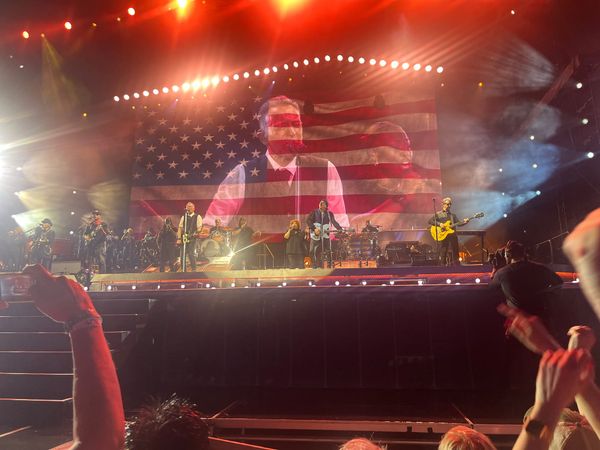
In Springsteen’s case, it’s more accurate to call this process of ideological articulation a re-awakening—not a conversion of some rich rockstar to a set of fancy out-of-touch elite values, but a return of Doug and Adele Springsteen’s kid to the values with which they raised him in post-World War II America. Since 1985, Springsteen has consciously embraced his union roots and his immigrant roots as much as he has embraced his musical roots. As a man who was literally homeless in the early 1970s, he has remembered the urgency of not knowing where your next meal is coming from and has supported food pantries for the homeless and working poor. The personal aspect of this return to bedrock values is perfectly captured in one of Springsteen’s most moving twenty-first century songs, the song with which he purposefully follows “American Skin” on this tour: “Long Walk Home.” In concert now, the screens unironically display a large American flag as Springsteen sings the essential lines:
Your flag flyin’ over the courthouse
Means certain things are set in stone.
Who we are, what we’ll do and what we won’t.
But after that soaring moment, of course, the mood sinks back to reality: “It’s gonna be a long walk home.”
Is Bruce Springsteen preaching to the choir? Aren’t all entertainers, if they don’t work hard enough? If we’re going to be honest, don’t most audience members go to a concert (or a movie or a play or a standup set) to escape, to turn their minds off? Not to question the man that so many people tell me may be my Boss, but at the end of every hard-earned day, most people don’t want to find a reason to believe. They want to be gently reassured that the reason that they already have to believe is just peachy, thank you. That holds for reactionaries, conservatives, moderates, liberals, progressives, and revolutionaries of all ideological stripes, sexes, genders, sexual orientations, races, ethnicities, and (oh yeah) classes. Don’t take Mike Pence too much to task for his negative reaction when the Broadway cast of Hamilton tried to school him about American history. In our off-hours, most of us aren’t looking for challenges, at least not to ourselves. We want reassurances, whether angry or bucolic, echo chambers that reflect the ideological noise inside our own heads right back to us, whatever its emotional key or instrumentation.
This is a conflict with which Bruce Springsteen has been wrestling since the 1970s at least, since he first started regularly playing to arena-sized audiences with which he had to struggle to find a new form of honesty and intimacy. The more serious and later political songs were surrounded by good-time anthems, and there were oldies at the end to send the audience off with a comforting little dose of nostalgia. One of the profoundest changes of Springsteen’s touring history is that after a while the reassuringly nostalgic oldies that he played in his encores became his old songs rather than the songs to which he had listened when he was growing up. “Born to Run” and “Dancing in the Dark” are the dessert now, the homecoming for the enraptured audience, rather than old girl group songs or r&b dance numbers.
On this tour, though, Springsteen is going all out. Even the songs from Born in the USA, a release that he once called his “purest pop album,” are reborn and reinterpretable in this specifically politically charged setlist. Back in the mid-1980s, the “war outside still raging” about which he sings in “No Surrender,” for example, had seemed to refer to Springsteen’s attempt to crack the Billboard Top 10 for the first time in his 30s. But last week, sung right after the revolutionary “Clampdown,” “No Surrender” suddenly felt like the sort of political song that John Kerry had tried to turn it into during his 2004 presidential campaign. In this context, the “war outside still raging” was the war against unfeeling fascism that Springsteen had much more dimly grasped over fifty-six years ago when he rode a bus down to Washington DC to protest the US government’s expansion of its war into Laos and Cambodia.
Just before the final song on all dates on the Land of Hope and Dreams tour, Springsteen makes pretty much the same speech every time, with some local details dropped in (just as Ronald Reagan had done with his standard reelection stump speech when he visited Hammonton, New Jersey, over four decades ago). In the name of the late Renee Good, Springsteen encourages his audience to engage in purposeful, peaceful engagement with those who hold opposing views. In the name of the late John Lewis, he exhorts them to get into some good trouble—peaceful good trouble, but active engagement with the injustice and intolerance before them nevertheless. The way that he has framed all this over the last three hours, none of it is new. It is renewal, revival, awakening, re-awakening. It’s the step-by-step path that leads to a long walk home.
Last weekend, the current presidential administration threw an explicitly Christian revival called Rededicate 250 on the Mall in Washington. According to the best estimates, it drew about fifteen thousand people. Thousands more than that attended the E Street Band’s American revival last Thursday night at the Barclays Center, and that was just one date on a twenty-one-date tour that is attempting to inspire what Jonathan Edwards, the eighteenth century originator of the first “Great Awakening,” would have called “Ardour” in its audience’s souls.
Nearly twenty-six years ago I came home from Madison Square Garden and started an essay that grew too big to still be an essay entitled “Bruce Springsteen Has a Problem with His Audience.” Last week, I think I saw at the Barclays Center that Bruce Springsteen doesn’t have as much of a problem with his audience as he used to—or rather they don’t have as much of a problem with him. And when I left that arena, I felt (perhaps foolishly) that not all the people in that audience were just going out to buy merch. Many of them were renewed, and maybe reawakened. Some of them—some of them—were going to go out, maybe to cause good trouble, maybe just to try to talk across divides, but to start walking toward a place that we never should have left, if we were ever actually there in the first place: the shiny promise of a Land of Hope and Dreams.
Marc Dolan is the author of Bruce Springsteen and the Promise of Rock 'n' Roll and is Deputy Director of the MA Program in Biography and Memoir at the City University of New York. He wisely eschews social media.