Remembering "Live 1975-1985" 40 Years Later
“Why did a record album with almost no new songs have people lining up at record stores around the block?”


40 years ago in November, thousands and thousands of Springsteen fans all over America stood on line and waited to buy a copy of Live 1975-1985. I woke up early and headed to Tower Records at 4th and Broadway and stood behind the blue NYPD wooden barricades, waiting for the truck to arrive and for the store to open early and put the album on sale. “I’m sick right now, at home,” said many a fan interviewed while waiting or after purchasing. There would be hundreds more of these sudden illnesses all across the country.
While we waited, there were debates about the tracklisting (and we’ll discuss this later), but most of those guys got shouted down because most of us didn’t have the $75 (which is about $230 in 2026 money) to buy bootlegs on the regular. I owned three vinyl boots (Piece de Resistance, You Can Trust Your Car To The Man Who Wears The Star, and I don’t remember or have the third one because someone I lived with stole it.) Tape trading was a thing by then, but you had to be tapped into those networks and most folks didn’t have the time or the energy. So an official Bruce Springsteen record you could just walk into your local record store and purchase was a big fucking deal.
And I’m honestly not exaggerating: the release of 75-85 was the subject of local news stories around the country and it was also on the national television news networks, not just MTV.
“Why did a record album with almost no new songs have people lining up at record stores around the block?” wondered Dan Rather on the CBS Evening News.
Mary Hart on Entertainment Tonight informed viewers that some people missed work to pick up this particular package:
And of course, MTV was there, capturing the frenzy at the Tower Records at 4th & Broadway. I specifically remember a whole bunch of folks waiting who had called out or called in late for work or school did NOT want to have their faces on camera. (Of course, when I walked into my office, my boss asked me how the album was, but I made it there on time.)
(I particularly enjoy the very local accents in this one.)
There was a dedicated David Letterman Top Ten about the box set which I have not been able to find video of anywhere, titled “Top 10 Complaints About The New Springsteen Album,” with two items as follows: “Wife Julianne’s horrible screeching on ‘Give Peace A Chance’ mars side two” and “He confesses to a series of unsolved murders on side six.”
The release of 75-85 was also a popular news story in print media across the nation. Some of this definitely had to be because there was a Springsteen fan working at one of the wire services. They sent out a boilerplate story (with the basic details that local papers could then customize to their audience) and called it “B-Day” and suddenly, November 10th was “B Day.”
The print news stories are charming in the extreme, detailing how the stores were constantly answering phone calls asking about the record. The smart ones took names and sometimes deposits to hold a copy. “Every other call was about Bruce. Every other person at the counter wanted to get it. They were driving us nuts,” said the manager of Musicland in Springfield, Missouri, who didn’t get their shipment until 4:30pm on release day, in a story titled, “Fans with hungry heart for ‘Boss’ Flood Stores.”
“A delivery truck was not born to run,” explained the reporter for the Springfield News-Leader. “We’ve got them well guarded,” assured the manager of Musicland in Waterloo, Iowa, when asked if the high price of the 5-LP set would make it prone to shoplifting. The same story noted that “One woman even waited from about 10 a.m. Monday, when the store opened, until UPS delivered the record at 1:10pm,” according to the associate manager of the Musicland in Crossroads in Iowa.
The Rochester, New York Democrat and Chronicle sent a reporter down to the House of Guitars, but the truck was nowhere to be found. “The truck. Where was the darned truck?” the story opened. “But the records weren’t in the store at 10 a.m. when the store opened. Nor at 11 a.m. Nor at noon. They were in the truck. And the truck was somewhere on the road. So everyone waited patiently.”“If my wife had a new baby I wouldn’t wait a couple of days to see it,” explained one fan. “Why should I wait for this.” “You just gotta be the first,” said another fan. “It just wouldn’t be the same if we got it at the same time as everyone else.” (The truck finally arrived at 1pm.)
In London, Kentucky, the Sentinel-Echo reported that all local record stores had sold out of their stock, with the manager of one local store explaining that he’d travelled to Cincinnati to make sure their store would be the first in the area to have the record. The fact that the album shipment didn’t reach Sioux City, Iowa, on time made it front-page news. The fact that it did arrive on time was also page one news in Detroit (byline courtesy former CREEM editor Susan Whitall!)
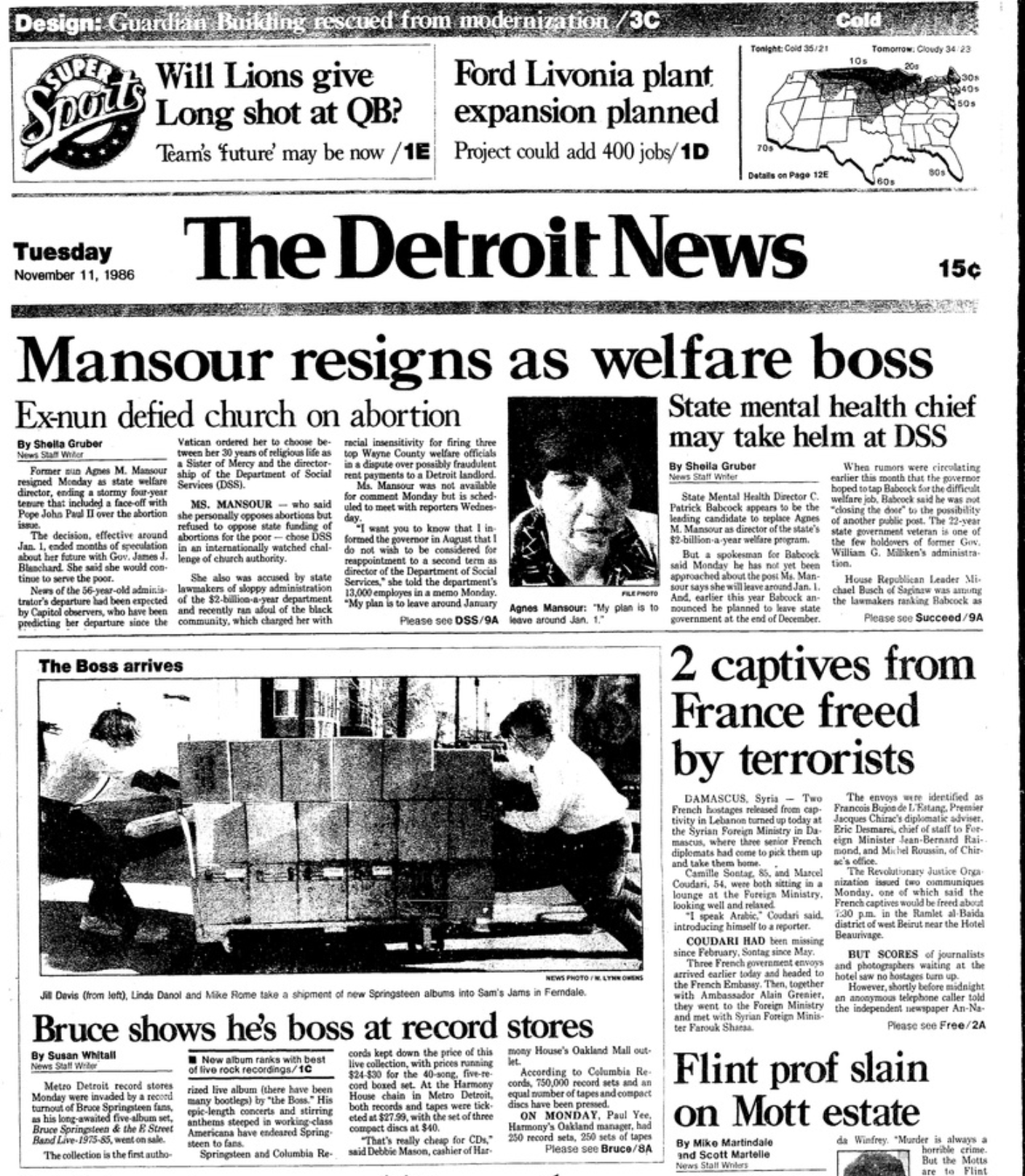
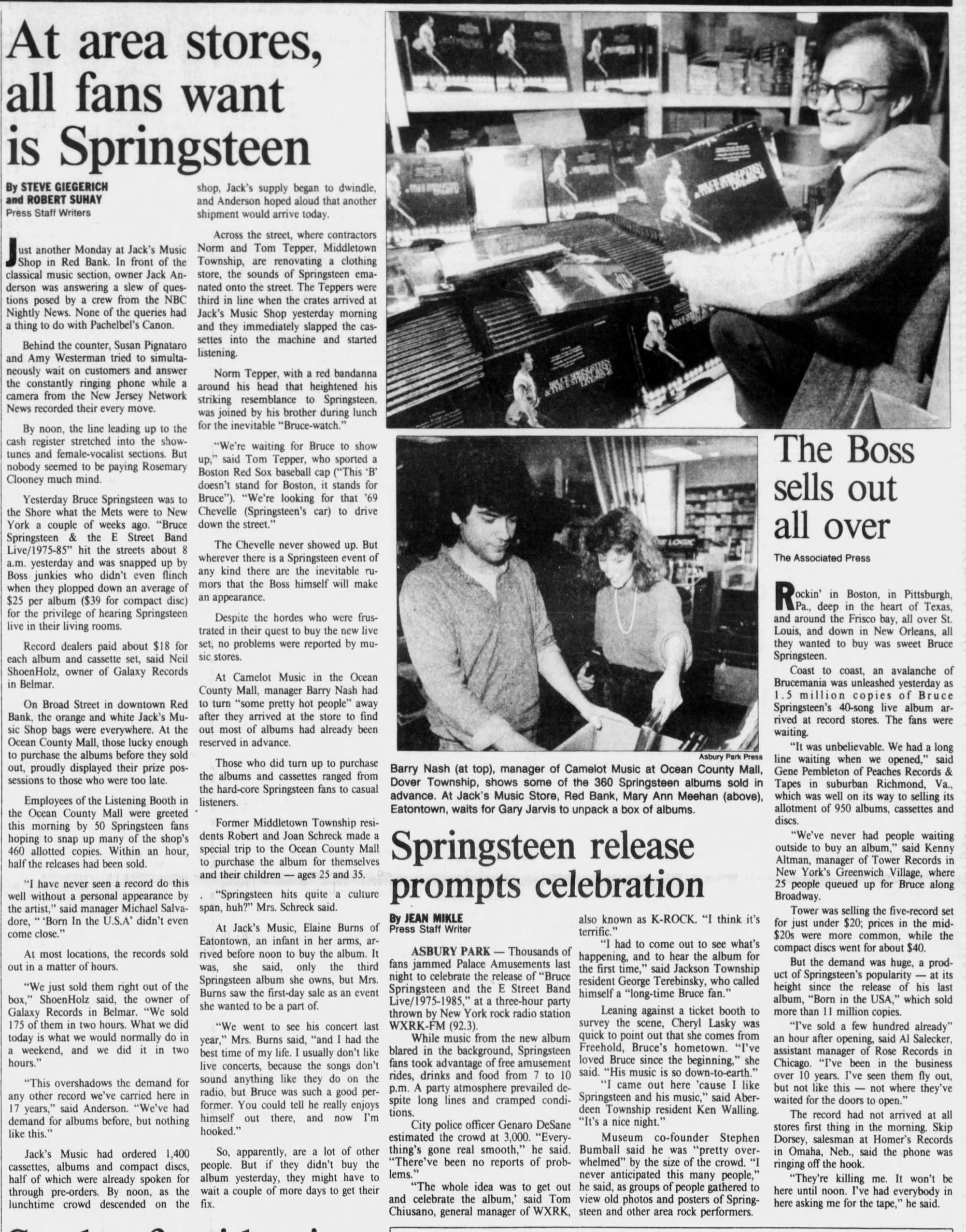
But there were headlines everywhere from Jackson, Mississippi to Boise, Idaho, Pensacola, Florida to Wausau, Wisconsin. And of course, the Asbury Park Press went to (you guessed it) Jack's in Red Bank.
The NY Daily News touted, “Only one can be Boss: Madonna doesn’t have prayer as Springsteen disc raises hell” and “Look for Bruce under spruce.” The AP interviewed Stephen King, “among the first in line at Strawberries Records & Tapes, arriving in a limousine and leaving with three sets of records and one on compact disc. ‘I got some other stuff to do, but this is the most important piece of business,’ he said.”
The Trenton, NJ Times spoke with none other than Ed Sciaky. “'This is not a definitive history of his live shows,' says Sciaky, with mixed feelings. 'It’s more a live history of his songs.'” Sciaky was particularly upset about the absence of “E Street Shuffle” (“the one he gets the most requests for and a trademark of the early years”) and, of course, asks the #1 question we all asked back then: where is “Jungleland.” Sciaky termed its omission “a shocker, just because it really became a trademark as one of those that took off in live performance just for the drama of it.”
“I hate to be negative,” he continued, “because I haven’t heard the records. But for the hardcore Bruce fans, the first things that come to mind are the things that are not on there And that’s not really fair…I remember when his sound man couldn’t afford to spend $5 a night to tape the show on cassette. Where’s ‘73 and ‘74? That’s what’s killing people. They’re anxious to get (the package), but it’s a little frustrating.” Thank you, Ed Sciaky.
Hilariously, multiple record store owners and clerks insisted that “The record is going to be a big seller, sure, but I doubt whether it’s going to create hysteria,” said the manager of the Sam Goody’s in the Monmouth Mall, right in Bruce’s backyard. “We’ll sell it consistently, but my personal feeling is that It won’t be anything like Boston (which recently released ‘Third Stage,’ its first album in eight years, and watched it go to No 1 in three weeks),” insisted the manager of Turtle’s Records in Atlanta. “We sold about 74 copies per hour of the Boston album. People had been waiting years for that. Springsteen’s nothing new.”
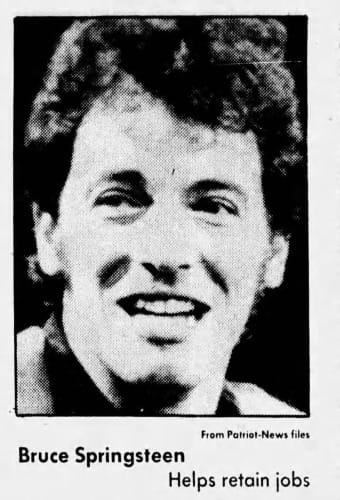
Another detail that CBS made sure to circulate was that the demand created by 75-85 kept a record pressing plant open. An AP story noted, “Springsteen albums may save jobs,” the gist of it being that CBS needed as many factories online as possible in order to fulfill all the orders (and even with that, there are still many, many news stories about stores running out or never receiving their copies). But it was very clever to seed this particular one.
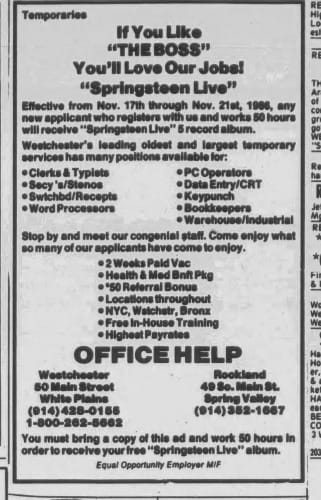
This was not the only non-music kind of ad offering the box set as bait but it is probably my favorite.
Backstreets initially reacted to the release of the box set by publishing lists of alternate tracklists from writers and affilated folks. I appreciated that Jonathan Pont and Erik Flannigan made sure to specify dates while everyone else just made lists. I think this approach was absolutely a reasonable reaction, especially given lead times, but what's missing to me is explanation from each contributor as to why they picked what they did. I would have liked to have seen some tough questions and hard constraints, because that's what makes you have to defend your choices. (They also solicited reader feedback for a later issue but I couldn't find where that ended up, probably because by the time they had set a deadline, Tunnel of Love started.)
My personal take at the time was that the omission of "Jungleland" was inexcusable, especially if you're going to lean so hard on the 7/7/78 Roxy show (which has eight tracks represented), just use that! But I did not know what they had done to "Backstreets" until years later when I got my hands on a good boot of the show, and then I was livid. (And if this is the first you are hearing of this botched surgery, you don't even have to leave the house to get annoyed.)
In terms of rarities, I always wanted "Thundercrack" – the day Tracks showed up, it was the first thing I listened to – and I feel like the absence of "Incident" is another big miss.
As Ed Sciaky notes above, this is a live history of his songs and not meant to be a concert. So I'd swap "Paradise by the 'C'" (even if it was my outgoing answering machine message for a very very long time), "Fire," "Raise Your Hand" (another answering machine fave, just that spoken intro) and we did not need "Jersey Girl" because it had just been released on the single (and putting it on the box set made it seem like it was a bigger deal than it ever actually was).
"Prove It All Night" is also a curious omission in my mind. "Growin' Up" is important but I never liked the edits done to the story and if we're cutting for the sake of time, then leave it out. And I understand thinking that there was no point including the Detroit Medley given the definitive version existing on No Nukes, but that wasn't a Bruce Springsteen record and this is called Live 1975-1985 and the Medley was a more important element to a Bruce Springsteen show than "Jersey Girl."
So now let's go refresh ourselves as to the party line on 75-85. As Dave Marsh wrote in Glory Days, "...once Bruce and Jon came upon the idea of doing a record that wouldn't be a live album or a greatest hits album so much as it would be the next Bruce Springsteen album, the issue resolved itself. This album would be as long as necessary to tell the story, and since the story was an epic, that might be real long."
The fulcrum that set the tone for the project was that 1975 Roxy version of "Thunder Road" that opens the record. "We put it on and one of us said, 'Well, if we ever did do a live album and it was a retrospective, that's what should open it.' And from that point on that's always been the song that opened the album," Landau told Marsh.
Bruce and Landau began with a collection of "about 30" professionally recorded shows. By the time they brought in Chuck Plotkin, he had located more and so they were working with 50-60 shows, 200 hours of music. "We just tried to pick the best takes, " Bruce told Marsh. Apparently they did this just by hanging out at Bruce's house and listening to shows. "We just listened to music," said Plotkin.
"As Bruce put it, they were looking for the songs 'before they were institutionalized,' while their meanings were still fermenting." And they deliberately chose to include multiple songs from one concert to "increase the sense of continuity."
Bruce told Marsh that he was frustrated that "Glory Days" didn't make the cut. Chuck Plotkin lobbied for the version of "No Surrender" that did make it: "'Bruce said, "I don't think we have room for it." I said, "Bruce, this solo version of 'No Surrender' has literally saved me from depression and self-contempt on more days than I choose to tell you about."' It was difficult to find takes of "Born to Run" and "Badlands" that they liked. (The 11/4/80 version turned up late in the game apparently, and this is where I once again bang my head into the proverbial wall that the man in charge was so so so against documenting his band.)
However, refreshing my memory of all this history does not at all revise my initial criticisms.
I'm actually going to put this record on in the car the next time I have a trip long enough because I'm super curious what it will sound like all these years later. The last time I listened to it was in the mid 90s when I stumbled onto the CD version at a record store for like $5 and couldn't leave it there. It was in the car all the time for a while, where friends were more willing to listen to it because it sounded better than the other live CDs I'd generally have in the car.
But I also acknowledge that they had an impossible task, that they never would have made us all happy, that they did delight 99% of people who purchased the record, and they made history without even intending to. They were just making a record.