The Evolution of Born to Run: "Backstreets"
Side 1, track 4.

For the 50th anniversary of Born to Run, here's a track-by-track breakdown of the evolution of each of the songs on the record, going in order from start to finish. Side 1, track 4: “Backstreets.”
There isn’t a firm and clearly documented timeline that lets us nail down the exact moment Bruce Springsteen began writing “Backstreets.” Brucebase documents that there was a song called “Hidin’ On The River” that is an alleged early predecessor, but there’s no circulating lyrics or audio for it that I was able to locate. Studio logs point to a song called “Backstreets” recorded at 914 Sound Studios in October of 1974, but there’s no circulating version of it either. When the band finally relocates the recording session to the Record Plant, on May 19, 1975, we get another appearance of a composition using that title, and that’s where the song begins its in-studio journey.
I don’t think you can attach any kind of significance as to how long it took Bruce to get certain songs finished simply because of what was happening with the band in the 74-75 time frame. Yes, he was trying to write differently and the key to that was “Born to Run,” and the time frame for that is significant because it was about a creative breakthrough. But the rest of the songs didn’t necessarily take a long time to finish because of any inherent drama or backstory. I think many of the songs took a while to complete because Bruce and the band weren’t financially able to just focus on writing and recording the best record they could. They still had to tour and play shows in order to be able to maintain an audience who would be interested in buying said record, and prior to the move to the Record Plant in April '75, they were recording at a studio located in a very inconvenient location for a bunch of guys from the Jersey Shore. This is before taking into account that studio’s various disadvantages, like a piano that was always going out of tune.
Bruce doesn’t talk a lot about “Backstreets.” It’s not discussed in any detail in Songs or his memoir. When he gave the keynote address at SXSW in 2012, he briefly touched on it, while alluding to the melodic (and emotional) connection between “Backstreets” and “Unchained Melody.” He doesn't mention the latter by name but that’s what it sounds like to me (listen at the 17:20 mark), and what he hums also bears a passing resemblance to the Five Satins “In The Still of the Night,” and probably many, many other doo-wop tunes as well. I'm actually personally grateful that he's never dissected the song. Part of its inherent power is in its deep mystery and its universality.
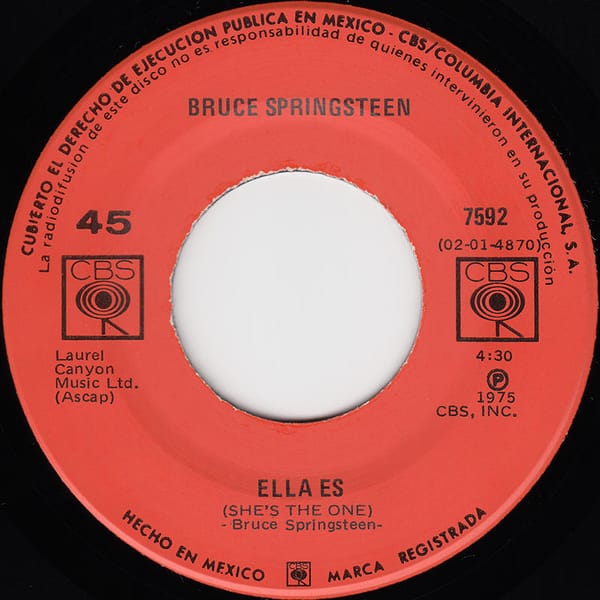
Thematically and lyrically, there’s a throughline from early versions of “She’s the One” (which we will discuss shortly as this series works its way through the album) and Peter Ames Carlin makes a pretty strong case that the woman these songs (and others) are about is probably Diane Lozito. But it also doesn’t matter who it’s nominally “about” because even when you call a song something like“Cynthia,” it does not mean that there is a Cynthia or that everything in the song is true. It’s a song, not a white paper, they’re not required to factually conform with reality.
What matters is whether the listener is drawn into the story and whether they’re emotionally true, and “emotionally true” also doesn’t mean factual, it means whether the song makes you feel the emotions the songwriter hopes that you’ll feel. Especially with Born to Run, just like he’s taking out some of the Jersey Shore specificity (as discussed in the 7/20/75 essay), he’s developing universal characters that aren’t just one person in particular.
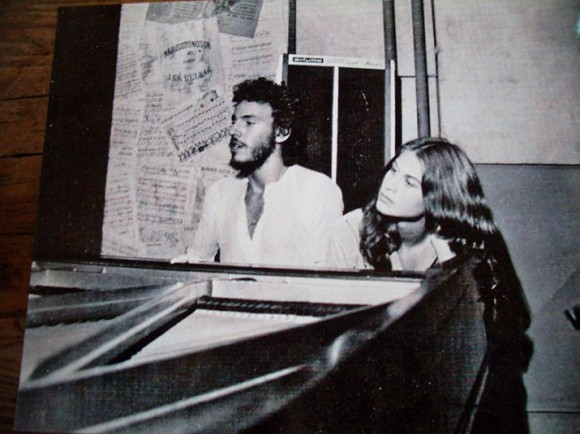
Sonically and dynamically, the demos/initial takes of “Backstreets” from the Record Plant will be comfortably familiar even to the first-time listener (at least the kind of first-time listener interested in listening to demos): the dramatic instrumental introduction featuring Roy Bittan’s piano, the slight guitar notes behind it, then the distinctive, syncopated drumbeat and the organ notes in the background, all leading up to that almost theatrical entrance of the vocals. Important to note is that Danny Federici does not play on the album version of this song. “It was not his strong suit, necessarily, to play structured parts,” Roy observed to Brian Hiatt.
The major changes from version to version of the demos are within the lyrics at various locations, an attempt to create the bridge, and a couple attempts at using string arrangements to enhance the song. Brucebase (click the “On The Tracks” tab) lists 9 different demos, two of which are not in circulation. I give you the links so that if you’re super-interested in the minute differences you can dig in. Here we'll focus on a version where the bridge is still missing and then the abomination of the versions with strings, because I think those are the crucial differences.
I’m using the bootleg known as Born to Run Sessions as the source here and am not renaming the sound files so that we don’t have potential rogue files out in the atmosphere further confusing things.
BACKSTREETS (DEMO 2) V1b (sorry, these are too large to embed)
A reasonable interpretation of the lyrics for this version is here (thanks to springsteenlyrics.com) even though they list it as “studio version 1.”
This version is characterized by very heavy organ in the intro here that fades out once the piano chords start, as well as a more dominant guitar line threading throughout. The girl’s name hasn’t been determined yet, he just vocalizes through it. It’s also “rolling on the backstreets” at one point as well.
Running in the dark, well, I found her where she fell / Just another wasted sister of the heartbreak hotel
I am so glad that he didn’t end up using “heartbreak hotel,” it would have been a reasonable and sincere homage, but there would have been too much focus on it in reviews. But it’s key here to observe that Bruce eventually gets to the final version by cutting out these first two lines, a classic case of what writers know as “killing your darlings,” or cutting out the cute or clever line you love so much but getting rid of it just makes whatever you are writing better. That’s what happens here. He still hasn’t written the next two lines beyond “slow dancing in the dark” but that’s how he gets there.
This version still doesn’t have a finished bridge, he’s just vocalizing, and there’s a line half off-mic that Brucebase interprets as “save yourself a new guitar string to get you around by” but I’ve listened to it a dozen times with headphones and different equalizer settings and 1) I don’t think that’s what it is and 2) I don’t think it’s an actual song lyric. I think he’s either talking to someone in the control room or trying to vocalize what he thinks that part of the song needs to sound like.
STRINGS
“... another mini-movie where Springsteen initially equated strings with capturing the cosmos. Yet every layer added seemed to only diminish its impact. How could that be?” Clinton Heylin, E Street Shuffle
I’m including both of these versions because just when you think they can’t ruin the song any more with the strings, they find a way! Heylin is right, all the strings do is destroy the song’s inherent power. V2A has a finished bridge but the lyrics are still being hammered out, and the Hard Strings version is lyrically very close to the final, except on the bridge.
I don’t think these are real strings because I don’t think the technique is sufficiently proficient, they sound choppy, but if anyone reading this either 1) knows or 2) knows something about 1970’s synthesizer technology, please weigh in. I don’t believe it is a pre-departure Suki Lahav either because I don’t think anyone involved in the recording process knew enough about how to record strings to multi-track them to sound like an ensemble. Also, hiring string sections is expensive, we’re already hiring horn sections, and hiring a string section would have required engaging someone to act as concertmaster and arranger.
Endless juke joints and Valentino drag / Watching the heroes working in the funhouse ripping off the f-gs
The bridge is still not baked. “Endless juke joints and Valentino drag” is set, but he’s trying to (I think) convey a sense of rootlessness and desperation. But Bruce has often talked about how Asbury Park in those days was the place for the people who didn’t fit in anywhere else. I’ve always read “Valentino drag” not as drag per se – although it could be, it’s a reasonable interpretation, especially when you consider the earlier rejected line about “Watching the heroes working in the funhouse...” as noted above – but a portrayal of lost souls trying to be someone they weren’t, someone they thought they had to be. The last of the Duke Street Kings.
The evolution of The teenage ice exploded in crazy senseless fights/Running off down the boardwalk away from the carnival lights into Running into the darkness, some hurt bad some really dying is a drastic improvement, but it will take one more round before Bruce lands on At night sometimes it seemed you could hear that whole damn city crying.
He’s kept the action but condensed the detail and the ambiguity makes it a better lyric while still serving the story. (Dave Marsh would note in his Born to Run, “Springsteen has temporarily slipped away from Jersey--there are a minimum of references to the Shore…This place may be Nowhere, but it is now a Universal Nowhere.”) It could be Asbury Park but it could be any city, anywhere.
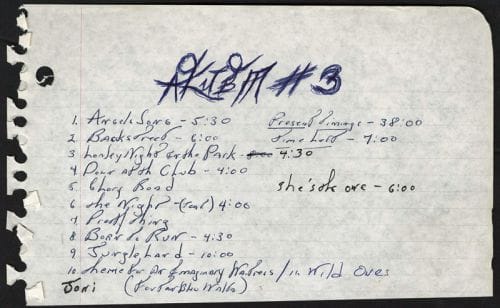
In potential album sequence lists, "Backstreets" jumps from either being at the beginning of the record or at the end of the record. None of these tracklists are dated with any certainty and so we can't tie them to particular days in the studio or other relevant events and thus play the fun game of "what happened to make the song move from side one to side two."
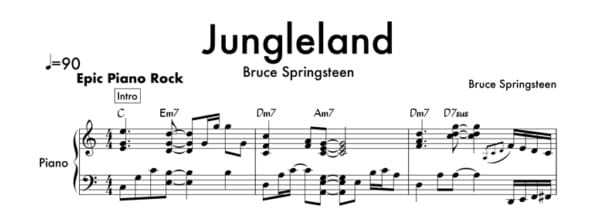
It gets interesting at the end, because Final Sequence, dated July 2, has "Jungleland" as the penultimate song on side one and "Backstreets" closing down the joint as the last track on side two, before Amended Final Sequence, dated July 7, that has the sequence that we all know and love. This is not a record where I have ever argued that there was a different and better sequence possible than what we ultimately got.
The first live performance of “Backstreets” would be a couple weeks into the tour, on August 8 at the Akron Civic Theater. This is a truly bonkers show we’ll talk about shortly but for now, let’s just focus on the live debut of “Backstreets,” falling in the back half of the set after “She’s the One” and before the last ever appearance of the instrumental known as “Funk Song.”
“Here’s something else from our new album, it’s called ‘Backstreets,’” Bruce mumbles into the microphone. I want to kill whoever thought this song required reverb and I realize that my complaint likely needs to be directed at a Mr. B. Springsteen (and it wouldn’t be the first time). There’s also a truly odd horn line that almost sounds like bagpipes – or maybe it’s a soprano sax? But this is why watching a song evolve live is a truly incredible thing.
One last thought: in his book, Brian Hiatt points out a potential and likely connection between “Madame George,” from Van Morrison’s Astral Weeks. Listen to it until the end, and hear the chants of “in the backstreets” and what Hiatt describes as “a melody that anticipates the whoa-whoas in ‘Thunder Road’.” I hear that, but I also hear tremendous similarities to the interplay with Suki Lahav’s violin, which is of course deliberate, we know what a huge fan he was of Van Morrison. I know Bruce wanted a violinist, but I’m honestly glad that he stopped going down that particular road. If he hadn't, we wouldn’t have gotten this version of Born to Run and we wouldn’t have gotten anything that happens later. Rock and roll didn’t need another Van Morrison, but it absolutely needed a Bruce Springsteen.
Sources:
- Brucebase
- Dave Marsh, Born to Run
- Brian Hiatt, Bruce Springsteen: The Stories Behind the Songs
- Clinton Heylin, E Street Shuffle
- Peter Ames Carlin, Bruce