The Evolution of Born to Run: "She's The One"
Side 2, track 2.
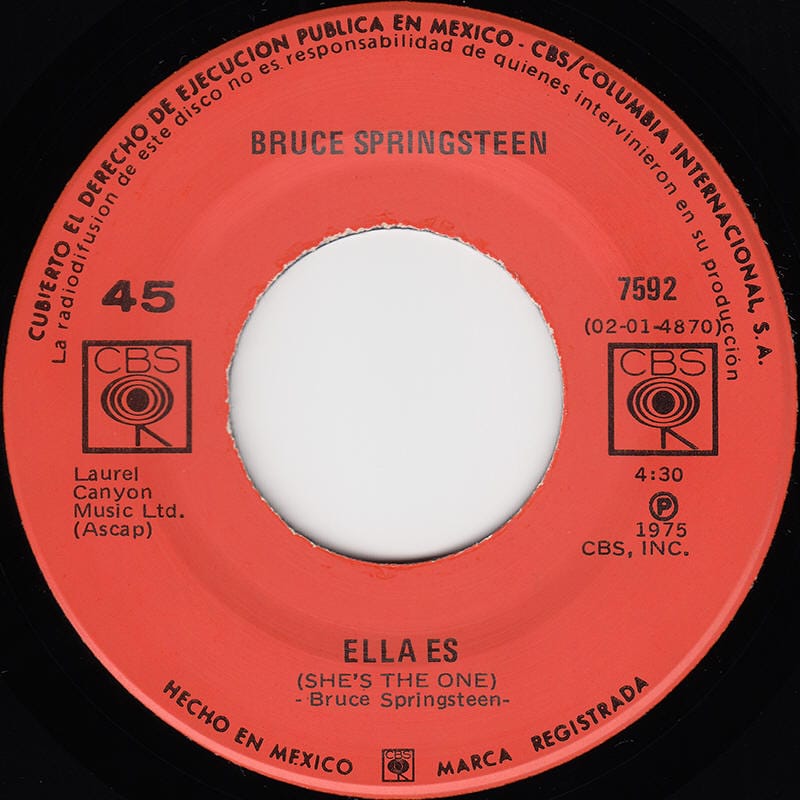
For the 50th anniversary of Born to Run, here's a track-by-track breakdown of the evolution of each of the songs on the record, going in order from start to finish. Side 2, track 2: “She's The One.”
“She’s The One” first debuted live at the October 4, 1974 show at Avery Fisher Hall (originally Philharmonic Hall, renamed in 1973, and as of 2014, David Geffen Hall) at Lincoln Center. It’s the building to your right as you enter the plaza, facing the fountain and the opera. This was a notable show because it was at Lincoln Center, because it was Suki Lahav’s first (and originally was intended to be the only) performance with the E Street Band, and because the show ended early because part of the seating area caved in. (More on this at the end of the essay.)
There isn’t a great recording of the show, despite JEMS attempting to work their magic a while back on the one extant recording we have.
She's The One - Avery Fisher Hall, 10-4-74
What we can hear of the introduction (in between everyone trying to have one-on-one conversations with Bruce) is similar to other early introductions of STO, where he’s talking about the Bo Diddley beat and says something along the lines of “Good girls get bad when they hear this beat and bad girls get worse," along with a comment that "husbands would rape their wives." This is probably the most objectionable thing Bruce Springsteen has ever said onstage but as you can hear from the crowd reaction, in 1974 this kind of sentiment was very well received.
This is probably why this bullshit introduction would continue into 1976. Besides from the rampant misogyny, what bugs me the most is that he didn't need any of this. It doesn't add to anyone's understanding of the song and quite frankly takes their attention away from the actual composition. “She’s The One” was never not a great song, you didn’t have to get the crowd excited before you started playing it to make sure they were interested and paying attention—the song itself would have done that, if he’d just given it a chance.
The early versions of “She’s The One” had a key lyric borrow from “Santa Ana,” which was written back in late 1973/early 1973 and was recorded during the Wild & Innocent sessions in June of 1973, and we didn’t hear it until Tracks. It didn’t make the cut, but he clearly liked “French cream won’t soften those boots, baby, French kisses will not break your heart” lyric so he repurposed it. The first verse in these early versions is solid and recognizable to everyone.
But Bruce still didn’t know what the rest of the story was. So the next couple of verses are a mashup of “She’s The One” and what we now know as “Backstreets.”
We hated her Ma, and we hated the Pop, hated the kids, and I hated them cops
I hated the lies and I hated the truth that run us down
Well, I hated that town, and what they did, I hated the way they made us live
I hated him and his fancy ways
And I hated you when you went away
And
And now your back and you're huddling in the corner and hate me safely like a child
You're back on your feet, come out into the street where love was danger and we were wild
Remember all the movies, all them movies, baby, that we'd go see
Trying to learn how to walk, talk, talk, walk just like the heroes we thought we had to be
Versions of these verses remained present in early live versions of “She’s The One” until the band stopped touring in early ‘75 to go into the studio. I’ve also wondered if the lines about “she was with me in New York the time they pushed me hard and I got beat” wasn’t related to the story that would become “Jungleland” or even “Meeting Across the River.” But the story is trying to do too many things, go in too many different directions. A lot of people want to insist that "She's The One" is about Suki Lahav, that's it, case closed.
According to Peter Ames Carlin, who spoke with the principals involved, the songs on Born To Run were inspired by Diane Lozito (who we discussed in the “Backstreets” essay) and just on simple chronology alone, that makes far more sense than the interpretation that “She’s The One” is about Suki Lahav. Yes, Suki evolved into a convenient onstage foil for Bruce, and yes, they were likely involved, but the song existed before she did, and its evolution isn’t as simple as “a fight with his girlfriend to a magical love song,” to quote Brucebase.
That’s because the original lyrics are about multiple different storylines. Yes, there's one that talks about a fight, but even within that verse, there is a larger concept involved, one that I have wondered if is related to "Meeting Across The River" and/or "Jungleland." Calling "She's The One" "a love song" is like saying that "Thunder Road" is about a dress, it's zeroing in on one aspect and ignoring everything else around it. It's a gross oversimplification. STO is a song about obsession and heartbreak and the feeling of being caught up in overwheling emotions you don’t understand and can’t control. It is far, far beyond just “a love song.”
This is also the point in his songwriting career where Bruce Springsteen was explicitly trying to write songs that were less blatantly specific so that they could find acceptance across a larger audience beyond the Jersey Shore. As Dave Marsh wrote in his Born to Run, “his place may be Nowhere, but it is now a Universal Nowhere.” It doesn’t mean they weren’t “real,” it just meant they weren’t strictly autobiographical or about one specific incident with one specific woman.
By splitting the “Backstreets” story line out of “She’s the One,” it meant that he could keep the mystery of the former—is Terry in ‘Backstreets’ a boy or a girl, as the eternal message board discussion asked—and let that story make sense no matter how the listener wanted to interpret it. That gave "She's The One" the ability to focus so exquisitely on the madness.
That is what is genius about these songs. Which is another reason that 75/76 introduction is so infuriating. The song was deeper and more complex than he was giving himself credit for.
Demos & Early Versions
We do not have precise recording logs but Clinton Heylin asserts that the first attempt at a studio take (which may or may not be this particular version) could have been recorded anywhere between later in October of 1974 after its live debut until April of 1975, by which point the band had decamped for the Record Plant.
She’s The One - Recorded October 16, 1974 at 914 Sound Studios [From E Ticket Revisited]
Lyrically, the song is as discussed above. The sax solo is present.
The lyrics are conveniently almost identical to a live version performed two weeks later at Boston Music Hall on October 29, so you can follow along.
SHE’S THE ONE (DEMO) V2 [From The Born To Run Sessions]
Listen to that 70s style synth fade in!
The highlight of this demo is how high the guitar is in the mix, it is just raw and intense emotion. There’s no sax solo, and Bruce is singing his version of what he’s hearing in his head for the chorus, which is absolutely fascinating to me. It sounds like this was a track where Bruce was just trying to get it all down emotionally. It’s also about two minutes shorter because there’s a missing verse, which, if this was meant as a scratch recording for the band, makes sense he wouldn’t bother to track.
I wish I could tell you more about when this was recorded or where it came from, but the bootleg I got this from has absolutely zero attribution. Maybe someone reading knows?
Avery Fisher Hall:
This was a notable show because it was at Lincoln Center, because it was Suki Lahav’s first (and originally was intended to be the only) performance with the E Street Band, and because the show ended early because part of the seating area caved in. I would like to get to the bottom of this situation and have a great contact at Lincoln Center, but it is the holidays so this investigation will have to be tabled for now.
According to attendee recollections, it was only a small part of the venue and only a few people and no one seemed to sustain serious injuries that we know about, which is probably why this isn’t a bigger deal in Springsteen history. From what I know about older New York City theaters is that the crowd probably rushed the stage onto the orchestra pit area and that platform wasn’t meant to sustain that kind of weight. I offer this because I was present at a show at the the Beacon Theatre years ago where the headlining artist didn’t like that the crowd was so far away from the stage and they tried to encourage the audience to rush the stage, only to be told by their tour manager that it wasn’t safe for precisely this reason. (The Beacon had a pipe organ in that area which has subsequently been filled in.)